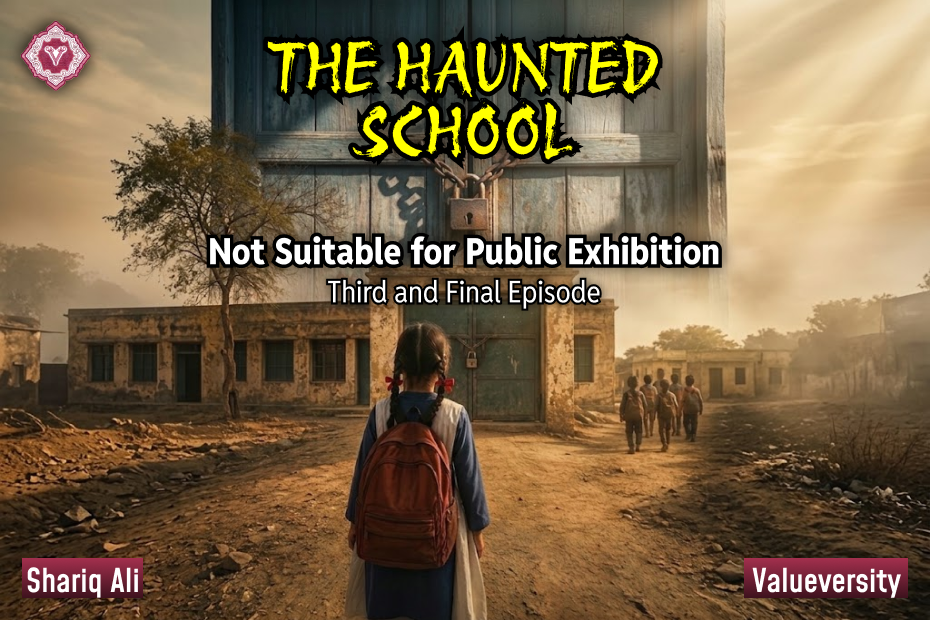
The Haunted School
Not Suitable for Public Exhibition
Third and Final Episode
Shariq Ali
Valueversity
Rabia’s question had travelled far beyond the boundaries of her village.
“Why is my school closed?”
When Seemab Gul gave that question the language of cinema, the story of a small Pakistani village found its way onto screens around the world.
Ghost School had its world premiere at the Toronto International Film Festival in 2025.
Then its journey continued.
At the Red Sea International Film Festival in Jeddah, it was included among films selected for children and families. At the Indian Film Festival of Los Angeles, the film received an honourable mention for its social realism and sensitive storytelling.
In May 2026, Ghost School opened the UK Asian Film Festival at BFI Southbank in London.
This was not merely the international journey of a film.
Rabia’s question was travelling with it.
It was the question of a child asking for an education.
But then the story took a strange turn.
The film was finally to reach the very place from which its story had emerged:
Sindh.
Ghost School was filmed in Chashma Goth on the outskirts of Karachi and in another nearby village. The filmmaker drew the substance of her story from the realities of life in these communities.
But in August 2026, the Sindh Board of Film Censors refused to grant the film a certificate for public screening.
The decision declared it:
“Not suitable for public exhibition.”
According to filmmaker Seemab Gul, no detailed explanation for the decision was provided to her. She also stated that neither the federal censor board nor the authorities in Punjab had raised such an objection to the film.
Sindh’s Culture Minister, on the other hand, maintained that the censor board is an autonomous body and must have had reasons for its decision.
Perhaps there was a reason.
Disagreeing with a film is also a right. Its narrative, symbolism and conclusions can be criticised. A censor board also has its own legal powers.
But here, the question becomes larger than the film itself.
Should a society be afraid of art that reflects its problems—or should it engage with it?
Ghost School is not an official report.
It is a story.
A story seen through the eyes of a child.
And perhaps this is precisely the power of art: it gives a human face to vast and impersonal statistics.
“Children deprived of education” is a number.
Rabia is a human being.
We may forget a number.
But the image of Rabia standing before her locked school may remain with us a little longer.
And perhaps that is why works of art like this matter.
They make us see what we have stopped noticing simply because we have seen it every day for too long.
We should also remember that this is not the failure of one provincial government, one political party, or one particular era.
Educational deprivation in Pakistan is a national problem stretching across decades.
It demands collective accountability more than political blame.
And perhaps that is why, rather than preventing a film from being seen, it would be more useful to watch it, disagree with it, question it—and answer the questions it raises.
Now, for a moment, let us return to the scene where this series began.
Morning sunlight.
An unpaved road.
Schoolbags on small shoulders.
Rabia and her friends.
The school stands before them.
There is a lock on the gate.
Rabia asks:
“Why is the school closed?”
She is told:
“It is haunted.”
She refuses to accept the answer.
She asks a question.
From that question, a story is born.
The story becomes a film.
The film travels around the world.
And then, in the very province of Sindh where that story was born, it encounters another locked door.
The first lock was on the school gate.
The second was on the cinema screen.
Perhaps now the decision is ours to make.
Where does the real haunting lie?
In the abandoned school?
In a system that has failed to bring education to its children?
Or in the silence that, rather than confronting difficult questions, simply closes another door in front of them?
And if a ten-year-old girl has the courage to question why her school is closed—
do we have the courage to listen to her question?