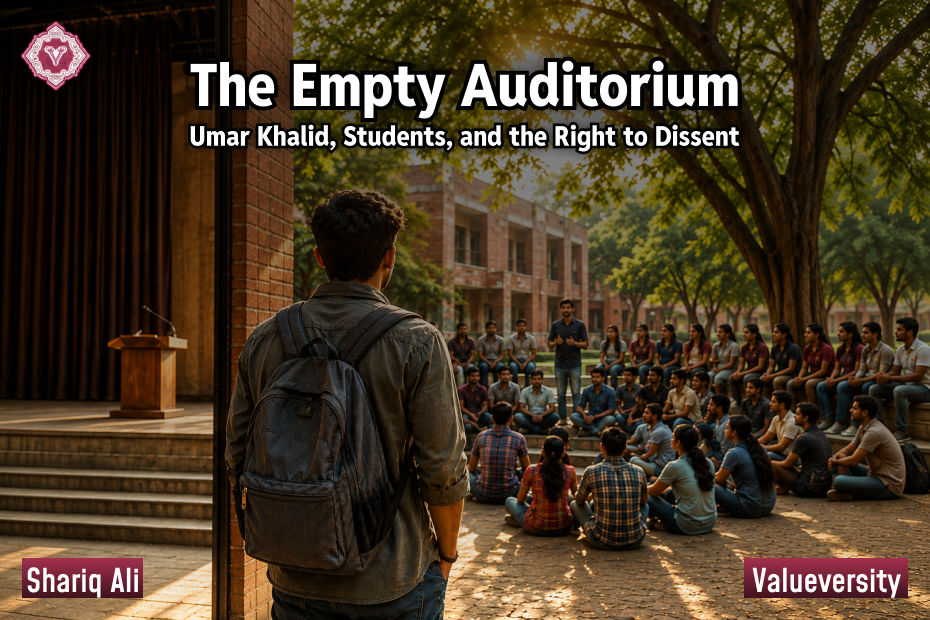
The Empty Auditorium
Umar Khalid, Students, and the Right to Dissent
Shariq Ali
Valueversity
A discussion about a book was scheduled to take place at Jawaharlal Nehru University in Delhi. The book was titled The Prisoner of Conscience, and its author was Umar Khalid, a former student of the university.
Students and faculty members wanted to gather and discuss the book. An auditorium had already been allocated for the event.
But shortly before the programme, the university administration withdrew permission.
The administration said that the organisers had not fully disclosed the nature and details of the event in advance.
The organisers did not accept this decision, and eventually students and teachers gathered outside the auditorium on campus and held the discussion there.
This is where the real story and the real question،begins
What, after all, is a university?
Is it merely a place where people earn degrees in order to find jobs? Or is it also a place where young people learn to ask questions, express disagreement, and challenge those who hold power?
Umar Khalid was once a student and researcher at JNU. He became involved in various political and social movements and was particularly prominent in protests against the Citizenship Amendment Act, or CAA.
Following the Delhi riots of February 2020, police accused him of being part of a larger conspiracy. He was arrested in September 2020 and charged under several laws, including India’s stringent anti-terrorism law, the UAPA.
The position of the state and the prosecution cannot simply be ignored.
They allege that Umar Khalid’s role went beyond speeches and peaceful protest, and that he was involved in planning, mobilisation, and a broader conspiracy.
In January 2026, while considering his bail application, the Supreme Court of India regarded the material presented by the prosecution as sufficiently serious at that stage to deny him bail.
But it is equally important to understand that the denial of bail is not a finding of guilt.
Guilt or innocence can ultimately be determined only after the full judicial process has been completed.
And this is where a much larger human-rights question arises.
Umar Khalid has been in prison since September 2020. More than five years have passed, yet there has still been no final judicial determination of his guilt in this case.
Amnesty International has strongly criticised this situation. It argues that years of pre-trial detention, stringent bail conditions, and prolonged legal proceedings raise serious concerns about fundamental human rights, including liberty, the right to a fair trial, and the right to peaceful dissent.
Amnesty also raises another important question: are laws created to combat terrorism being used in ways that risk creating an environment for dissenting voices in which the accusation itself effectively becomes the punishment?
Valueversity feels no need to portray Umar Khalid either as a hero or as a criminal.
If he has genuinely participated in violence or a criminal conspiracy, the state should present its evidence, the trial should be completed, and, if guilt is established, he should be punished according to law.
But when a person remains imprisoned for years while the case against him does not reach its judicial conclusion, the issue no longer concerns one prisoner alone. It becomes a question of human rights and the justice system itself.
Because justice does not mean only punishing the guilty.
Justice also means ensuring that punishment does not begin before judgment.
And this brings us back to that auditorium at JNU.
The role of students is not simply to accept everything they are told. The great tradition of universities has been built upon questioning, inquiry, dialogue, and dissent.
Freedom of expression, however, does not mean freedom to engage in violence, spread hatred, or violate the rights of others.
One of the most difficult tests of a democratic society is whether it can preserve this delicate boundary through law, reason, and justice.
The courts will decide the case of Umar Khalid.
But the questions raised by his story belong to all of us.
Can we defend the right to justice even of someone whose views we do not share?
Does a student have the right to ask difficult questions of the state, society, and the age in which they live?
And above all:
If freedom to dissent exists only for voices we like, can it truly be called freedom?