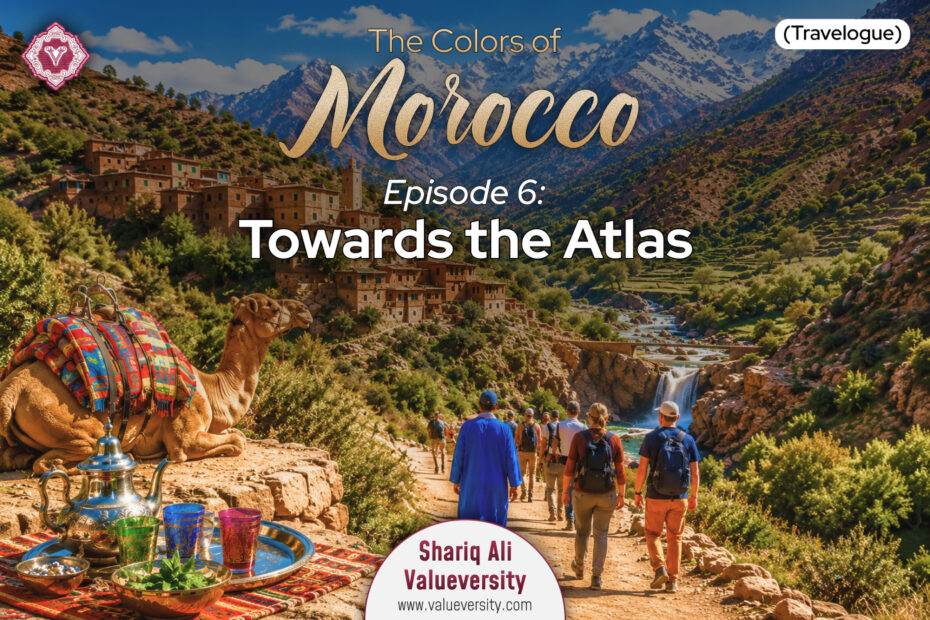
Towards the Atlas, Episode Six
Colors of Morocco
Shariq Ali
Valueversity
With the help of the alarm, we woke up a little earlier than usual. When we drew back the curtains, even at that early hour a few people could be seen downstairs, already swimming in the hotel’s pool.
After showering and getting ready, we went down to the hotel’s dining hall. Some guests had arrived before us. A five-star breakfast was laid out in the hall—everything halal. The live cooking counter was especially appealing, offering freshly made omelets to order. Rows of fresh fruit, all kinds of bakery items, and beverages—everything one could want was there. We enjoyed a hearty breakfast.
Then, in a pre-booked taxi, we headed to the designated meeting point for the Atlas Mountain tour.
Today’s plan was a visit to the Atlas Mountains.
Stretching across a large part of North Africa, this mountain range consists of several regions. These mountains have a deep influence on Morocco’s climate, agriculture, culture, and Berber population. Think of them as a symbolic representation of Morocco itself—ancient, silent, and dignified. For centuries, they have been custodians of Berber tribal culture, lifestyle, and resistance. The rocky valleys, earthen villages, olive and almond trees introduce visitors to the true soul of Morocco. In a way, the Atlas
Mountains are a living metaphor for Morocco’s history, culture, and natural identity.
The meeting point was at Jemaa el-Fna, right in front of Hotel Argan. There were still fifteen to twenty minutes before the tour began. Mona didn’t feel comfortable standing outside, so to pass the time we went inside and sat at an empty table. This waiting spot turned out to be a well-known and tastefully designed restaurant in its own right.
Breakfast was obviously out of the question, but to justify our seating, we ordered tea and coffee.
Moments later, a young waiter appeared with a traditionally decorated Moroccan trolley. Gleaming glasses, an ornate silver teapot—and then that distinctive Moroccan flourish: pouring tea and coffee from a height of nearly two yards into the cups. It wasn’t merely serving tea; it felt more like a circus performance. After this skillful display, steaming tea and coffee were placed before us.
A little while later, our tour van pulled up right in front of the hotel gate—a medium-sized HiAce van. This would take us towards the Atlas Mountains. The tour promised lush valleys, Berber villages, mountain roads, the interiors of traditional homes, the taste of local tea, and breathtaking natural scenery. We, too, were eager to see Moroccan culture in its most authentic form.
The driver stepped out of the van. He couldn’t have been more than twenty-four years old. His name was Jamal. Smiling, he introduced himself:
“I’ll be your driver and your guide for today’s tour.”
By then, a few more tourists had gathered. Our group consisted of six people in total: a middle-aged couple from Spain, and a young couple from Belgium—both students. Six individuals from different countries, languages, and backgrounds sat together in one van, smiling and instantly becoming fellow travelers headed in the same direction.
Jamal started the engine and drove skillfully. The daily bustle of the city slowly faded into the background.
After some time, we left the flat landscape behind and began traveling through gradually rising mountainous terrain.
After about an hour and a half, the van stopped near a small village for a short break. It was a tourist village. As we walked toward a restaurant, both sides of the path were lined with handicraft shops, local crafts, tea and light snack stalls, and a lively tourist atmosphere. I paused for a moment to take in the surroundings; the scene felt very different from the city of Marrakech. A winding road climbing upward, a stream flowing alongside it, and the first rising lines of surrounding mountains.
By the stream, some Moroccan youths were busy working in the fields. This was the first time I had seen them engaged in such work; otherwise, most Moroccan youth I had observed were connected to the tourism economy—as tour guides, hospitality workers, or salesmen in handicraft shops.
Our guide Jamal, a young man of twenty-three or twenty-four, was studying at university while working in tourism for the past three to four years—a quiet contributor to the tourism economy.
On Jamal’s slender, angular Berber face, the harshness of the Atlas
Mountains and the desert sun seemed to blend together. Dressed in jeans and a T-shirt, this university student—an expert driver and guide—was a compelling character: wheatish complexion, deep eyes, and quiet confidence.
The hardworking youths in the fields by the stream, however, perhaps had not been as fortunate in terms of education.
The stories of the greatness of Berber ancestors, heard in childhood by Jamal and those village youths, now seemed lost somewhere in the demands of daily livelihood. Yet Jamal still made a point, during his guided commentary, to speak of Berber history—of free tribes, their bond with the land, and the dignity of hard work.
How long these stories will continue to accompany the fast-paced lives of today’s Moroccan youth, one cannot say. Amid the labyrinth of education, employment, tradition, and the modern economy, these Berber narratives—striving to preserve an ancient identity—felt to me like a quiet, dignified journey of memory from the past and hope for the future.
To be continued…