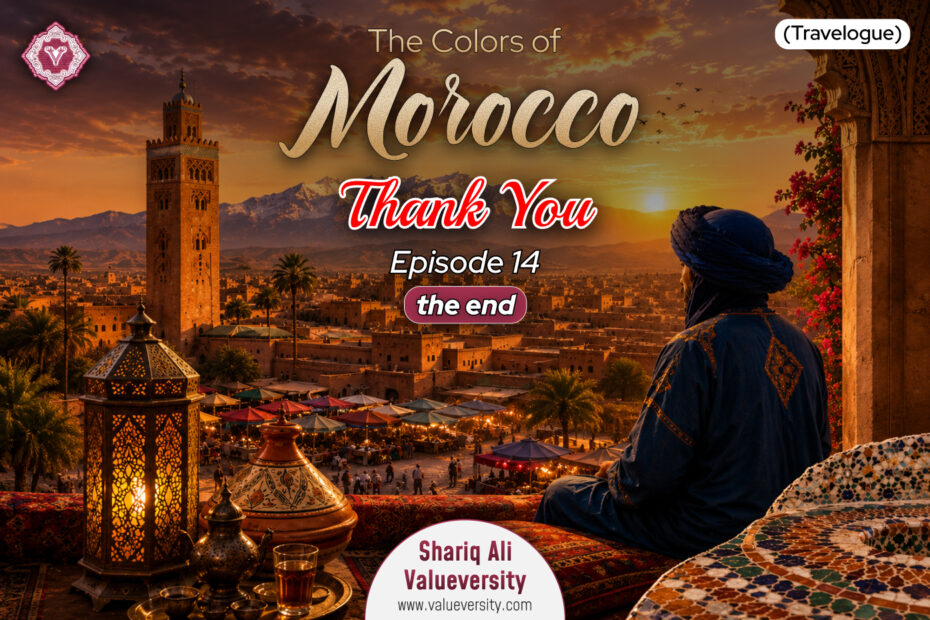
Thank You، Episode 14 and the end
The Colors of Morocco
Shariq Ali
Valueversity
By the time we returned from our Agafay Desert tour and reached the hotel, it was nearly ten o’clock at night. After spending the entire day under the blazing sun, I felt the need for some Panadol. I also needed a razor for the following morning’s shave.
When I mentioned that I would walk to the nearby central railway station to buy these items, Mona readily agreed to join me for a stroll.
Opera Plaza Hotel, where we were staying, is situated in a magnificent square. Directly opposite stands the grand National Opera House, while Marrakech’s central railway station occupies the left side. On the fourth side of the square, the entire wall of a large residential building has been transformed into a canvas displaying a huge portrait of a local Berber man dressed in traditional attire. The mural is a powerful expression of pride in Berber identity.
Even today, one can still feel the heartbeat of Berber civilization in this city. These ancient inhabitants of North Africa call themselves Amazigh, meaning “free people.” Their history stretches back thousands of years. Their language is written in the Tifinagh script, which continues to enjoy official status. Having survived for centuries in the harsh and unforgiving environment of the Sahara, they once guarded important trade routes across the region. Their cultural influence remains vividly visible in Morocco’s traditional carpets, jewelry, and handicrafts.
We left the hotel and, within two minutes, had purchased everything we needed from the shops still open inside the railway station.
The station building was brightly illuminated and bustling with activity. We decided to continue walking along the wide, beautifully maintained pavement beside the main road. Palm trees lined the walkway at regular intervals, accompanied by elegant lamp shades that seemed to embrace the darkness of the night, creating an almost dreamlike scene. Benches had been placed along the pavement, and on one of them sat an elderly traveler with his luggage, quietly observing the world around him. His train was probably not due to depart for some time.
It was quite late. He was alone, elderly, and physically frail. He also had luggage with him. Had this been Karachi, such a situation would have been almost unimaginable. Yet there was a remarkable sense of peace and security in the atmosphere of this city. There was neither fear nor anxiety on his face.
An involuntary wish arose within me: if only my own city could become a place where a vulnerable elderly person could travel safely at night.
My city, Karachi, where more than sixty-four thousand crimes were reported last year. During the first two months alone, thousands of mobile phones and motorcycles were stolen or snatched, while numerous citizens were injured or even killed while resisting such crimes.
We crossed the busy road to take a longer walk.
Marrakech’s traffic may not be as disciplined as that of some European countries, but overall it felt considerably better than expected. The city was alive and energetic, yet there was also a noticeable sense of order and confidence.
After spending some time walking and enjoying the nighttime sights of Marrakech, we returned to our hotel room and went to sleep.
The following day was our departure day. After breakfast, we packed our luggage and gifts. At noon, we checked out, left our bags at the hotel, and headed towards Jemaa el-Fnaa for lunch.
After wandering through the colorful streets and markets of Jemaa el-Fnaa, we enjoyed fresh Moroccan pomegranate juice one last time—a drink that had already won our admiration on three previous occasions. We spent so much time searching for the Marrakech Museum that we eventually had to postpone the visit. After lunch, we took a taxi back to our hotel, where a pre-booked taxi to the airport was already waiting for us. Collecting our luggage, we set off for the airport.
The airport’s impressive architecture beautifully combines traditional Moroccan and Islamic geometric designs with modern glass and steel. Solar panels installed on the roof and façade supply part of the airport’s electricity needs, while natural daylight is utilized very effectively throughout the building.
It is said that during the Second World War, this airport served as an important hub for American military air transport.
Today, it ranks among Morocco’s busiest airports.
Our aircraft took off, and as it climbed into the night sky, I looked out of the window at a mesmerizing sea of lights below.
The illuminated roads formed glowing ribbons, while countless golden lights stretched into the distance, twinkling like stars.
Somewhere down there were the ancient markets, historic buildings, silent desert expanses, mountain villages, delicious food, and warm-hearted people.
Gradually, the city lights faded into the distance.
Silently, I whispered to myself: Thank you.
Thank you for introducing me to new people, new cultures, and new ways of seeing the world.
Morocco is truly a memorable land, rich with beauty, color, culture, and the enchanting wonders of history.
Thank you, Morocco.
The End