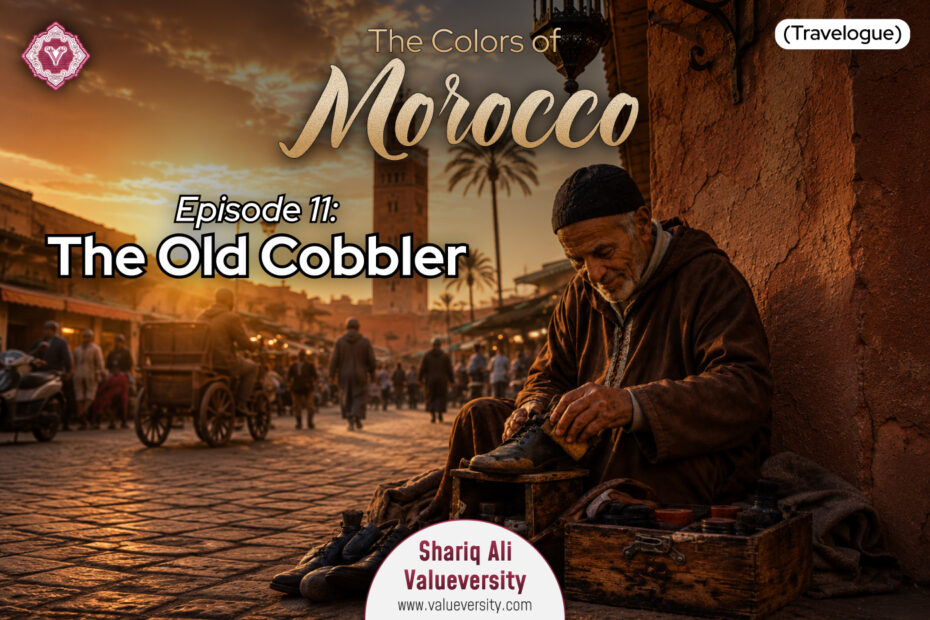
The Old Cobbler, Episode 11
Colors of Morocco
Shariq Ali
Valueversity
We woke up in the morning and headed to the dining hall for the lavish breakfast included in our hotel package. We chose a table from which we could watch the gentle sunlight dancing upon the blue waters of the swimming pool. The breakfast was indeed sumptuous.
Our pre-booked desert tour was scheduled to begin at four o’clock in the afternoon, which meant that almost the entire day was ours to spend as we pleased.
While having breakfast, Mona suggested that it would be a good opportunity to buy some gifts for the children. It would also give us a chance to explore one of the local shopping malls.
A quick inquiry at the reception revealed that Marrakech’s newest shopping centre, Menara Mall, was only a ten- to fifteen-minute walk away.
When we arrived there on foot, its exterior looked exactly like the modern shopping complexes found in any major city around the world.
An elegant entrance, glass walls and windows, brightly lit walkways, famous cafés, branded stores, crowds of shoppers, and tourists speaking different languages.
For a moment, it felt as if ancient Marrakech had faded into the background and a modern European city had appeared before us.
After choosing gifts for the children together, we noticed a large Christmas tree decorated inside the mall. We agreed that after spending an hour exploring independently, this would serve as our meeting point.
Mona headed towards the shops, while I walked out through the main entrance in search of fresh air and, perhaps, a glimpse of authentic Moroccan life.
I have always found ordinary people in ordinary streets and markets fascinating.
Across the wide road facing the shopping mall, I noticed a small market with a few narrow lanes.
I crossed the street and began wandering aimlessly.
After some time spent in observational drifting, I came across a bus stop. I sat down on a wooden bench in the waiting area, as though I too were a traveller.
I had nowhere to go, but I wanted to watch everyday Moroccan life breathing around me.
I wanted to observe those people who never appear in tourist brochures, yet whose lives sustain the reality behind the photographs.
Morocco is a country of nearly forty million people. Although located in Africa, its atmosphere carries a unique blend of Arab, Berber, African, and European cultures. Its economy relies largely on tourism, agriculture, phosphate mining, and small businesses. While major cities display development and modern infrastructure, everyday life for many people remains demanding and labour-intensive.
At the bus stop, some young people seemed in a hurry, some women carried shopping bags, and several elderly men stood quietly waiting. Unlike much of Europe, many older people here cannot afford a fully retired life. Pensions are available only to a limited number of citizens, social welfare systems are less comprehensive, and many continue working well into old age.
After watching me sit on the bench for some time, an elderly man approached.
He carried an old square wooden box in his hand. His face and hands were covered with wrinkles that seemed to hold the experiences of an entire lifetime. His clothes were simple but clean, and his eyes reflected intelligence and dignity.
He spoke no English, and I spoke no Moroccan Arabic, yet it was easy to understand the language of his hardworking hands.
Through gestures, he indicated that he wished to polish my shoes.
I hesitated. I was wearing an expensive pair of Skechers jogging shoes rather than leather shoes. I worried that the wrong polish might damage them. I took out some money and tried to offer it to him without asking him to work, but he smiled and declined.
His refusal surprised me.
The self-respect in his eyes seemed to say:
“I do not need charity. I work for a living.”
I immediately agreed.
From his box, he produced a small wooden footrest, placed my feet upon it, and began working with remarkable care. He carried every kind of polish imaginable, including coloured varieties and a transparent wax that was suitable for my trainers.
The care and skill with which he cleaned and polished my shoes suggested that this was not merely a source of income for him. It was also a way of staying connected to people, remaining useful, and preserving his identity.
A few minutes later, my shoes looked almost brand new, and somehow we had become friends.
As I watched him, I wondered about his life. Perhaps he lived alone. Perhaps he had a family. Maybe his children were still with him.
Perhaps he had once worked in an entirely different profession. Who knew what sort of treatment life had given him?
There, at the edge of a bus stop, two strangers spent a little time together as friends.
I would leave Marrakech in a few days, but perhaps he came here every morning carrying his wooden box, meeting countless people until late evening, forming countless brief friendships, and earning enough to keep his household going.
Outwardly, he appeared healthy, though he might have been struggling with illness.
In countries such as
Morocco and Pakistan, healthcare often seems divided between two different worlds. Major cities offer private hospitals and modern clinics, but for ordinary people reliance on public healthcare is still far from easy. In rural areas and among poorer communities, healthcare, old age, and employment are not separate challenges but different chapters of the same story.
Perhaps the old cobbler was one such chapter in that social book.
When he finished his work, he gave my shoes one final polish with a cloth and looked at me with quiet pride. There was a silent satisfaction in his eyes.
At that moment, I felt as though I had been granted a personal meeting with hard work, dignity, and human self-respect.
To be continued…