Berber Village, Episode Seven
Colors of Morocco
Shariq Ali
Valueversity
As the Hiace took a sharp turn at an altitude, it left the paved road and began moving along a dusty track. Passing through rough and stony paths, we entered a small Berber village nestled among the Atlas Mountains.
The mud-built houses appeared as though they were extensions of the very mountains themselves. The vehicle was parked in an open field, where a few other tourist cars were already present.
We then stepped into the Berber village. The walls of the few houses in this settlement were the same earthy color as the land. Their roofs rested on sturdy wooden beams. The Berber children playing in the lane glanced at us with curious shyness and quietly moved aside.
Our guide led us inside a local home—clearly a pre-arranged visit. The house had been prepared to warmly welcome tourists. We bent slightly to pass through a small wooden doorway, almost as if practicing traditional Berber humility.
The mud walls were noticeably thick, designed to keep out both heat and cold. Inside, there was a refreshing coolness. It became evident how effectively the thick earthen walls shielded the interior from extreme weather. Simple yet colorful carpets were spread across the floor, and the seating was arranged close to the ground.
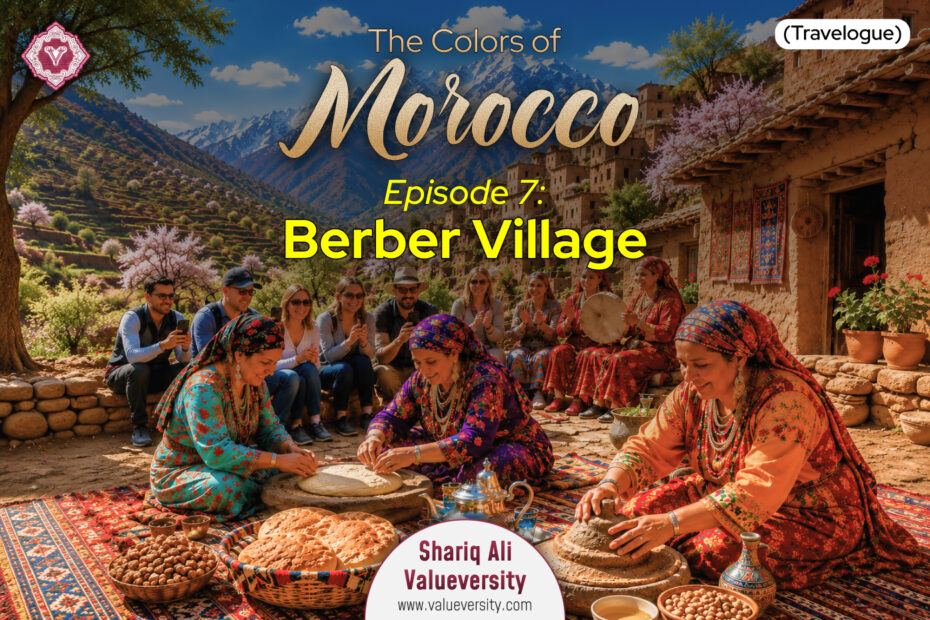
In the courtyard, welcoming music had been arranged.
Several local women—mostly middle-aged and elderly—dressed in vibrant traditional attire and jewelry, were playing the daf and other instruments while singing to greet the visitors. In the center, two or three women demonstrated how argan seeds are ground on a stone mill to extract oil, while another woman showed how traditional bread dough is kneaded.
The benefits of argan oil were then explained to us, along with gentle encouragement to purchase it.
The colorful attire and jewelry of the Berber women, their distinctive musical style, the rhythmic pounding of argan seeds, and the curiosity of the surrounding tourists together created a lively scene. After this welcome event, which lasted a few minutes, some visitors recorded it on their mobile phones.
We were then taken to another room of the house where floor seating had been arranged. There, we were served fragrant mint tea. Pieces of freshly baked Berber bread, honey, sweet peanut paste, olives soaked in olive oil, and local jams were presented simply in small clay bowls. It was dignified hospitality and sincerity—perhaps a natural trait of people living high in the mountains.
In this village, time seemed to move more slowly. The mud houses, wooden roofs, simple carpets beneath our feet, the steam rising from tea, the beat of the daf, and the shimmer of colorful garments—somehow, they reminded me of Ibn Battuta.
He was born in 1304 in Tangier, Morocco. Belonging to a family of judges, his ancestral profession was the judiciary, yet his heart was drawn more to travel than to the courtroom. At the age of twenty-one, he set out for Hajj and then spent nearly thirty years journeying across the world. He traveled through North Africa, Egypt, Syria, India, the Maldives, China, and Andalusia. His book Rihla still offers a vivid portrait of the fourteenth-century world.
…To be continued.