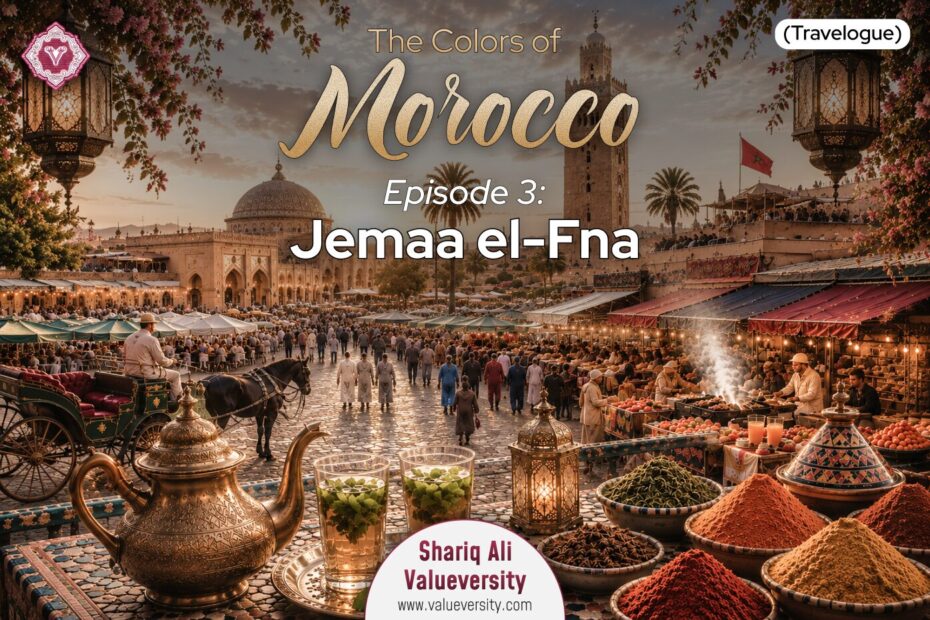
Jemaa el-Fna Episode Three
The Colors of Morocco
Shariq Ali
Valueversity
After resting briefly at the hotel, we took a taxi and set off to explore the expansive and historic part of Marrakesh—the Medina. It was early afternoon, yet the sun was gentle in temperament. The city was fully awake. The roads were clean and modern, though not entirely European in character; instead, they carried a warm, homely familiarity. Along the way, we passed several historic buildings and lush green gardens. In places, orange and lemon trees lined the pedestrian walkways beside the roads. After a short drive, the taxi dropped us at the edge of a vast open area, as vehicles were not permitted beyond that point.
This wide open square is called Jemaa el-Fna, and one might think of it as the soul of Marrakesh. An open central space, shops all around, juice stalls, restaurants, horse-drawn carriages waiting at one corner with people eager for a ride, guides calling out to tourists, and local shopkeepers—this was not merely a crowd, but a living, breathing cultural scene.
Moroccan culture is not the product of a single era or a single people. It is the result of centuries of civilizational interaction. Here lie the roots of the ancient Berber (Amazigh) civilization, upon which Arab, Andalusian (Muslims from Spain), African, and later European influences were layered. This is why Morocco simultaneously reflects both antiquity and modernity.
As we walked, a local guide offered his services. We agreed and spent some time with him. Soon it became clear that his knowledge relied more on legends, stories, and personal experiences than on historical facts. We promptly paid him, took our leave, and decided to explore on our own.
After wandering around the openness of the square, we chose to enter the surrounding narrow alleys. It was here that we encountered the true temperament of Morocco. These lanes are not merely marketplaces; they are centuries-old ways of life that still endure. Many shops are tied to the same craft for generations. Somewhere spices were being ground in the background, while jars filled with colorful, fragrant spices were beautifully displayed in front; elsewhere leather was being dyed, or metal was being shaped. These are the very crafts that were likely practiced in much the same way during the Middle Ages.
These markets are not only places of commerce but also social centers. People meet here, converse, drink tea, and discuss everyday matters. The local mint tea is not just a beverage—it is regarded as a symbol of hospitality and respect. Offering tea is, in a way, a seal of acceptance.
The blend of civilizations is also clearly visible in Moroccan clothing. Traditional djellabas and caftans are still common, yet young people wearing modern jeans and jackets can be seen alongside them.
I felt that
Morocco’s youth is not detached from the past; rather, they are moving forward while carrying their historical identity with them. This feeling was echoed in the music as well. In some restaurants, centuries-old Gnawa melodies resonated, while in modern cafés the beat of Western music could be heard. I enjoyed both, because each shared one common element—vitality and harmony.
After nearly an hour and a half of exploring the market, hunger reached its peak. We decided to dine at a hotel restaurant located at one corner of the square. Seated on the first floor, we placed our order.
The menu itself clearly reflected cultural fusion. The rustic Berber simplicity of tagine, the Andalusian elegance evident in pastilla, and the ancient homely tradition embodied in couscous. These dishes did not merely satisfy hunger; they narrated history.
Finally, we ordered mint tea. From the balcony, the bustling market stretched far into view—tourists in colorful attire moving through the open space, warm cups of tea in hand. It felt as though we were not merely seeing Morocco, but truly experiencing it—with an understanding of its colors, sounds, flavors, and traditions… to be continued.