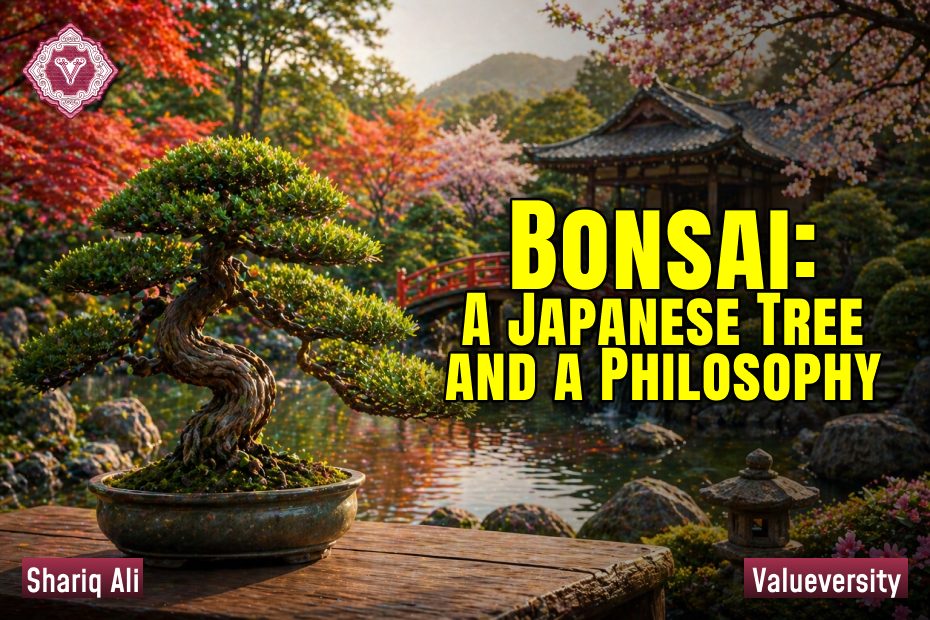
Bonsai: A Japanese Tree and a Philosophy
Shariq Ali
Valueversity
It was one of those beautiful spring days. Mona and I set out to visit London’s famous Holland Park. As we were making our way toward the park, we noticed a sign for the Kyoto Garden. We thought—why not pause here for a while?
As we stepped inside, a quiet and serene world unfolded before us. The gentle sound of water, lush green trees, and a sense of thoughtful design filled the space. It was here that our eyes fell upon a few tiny, yet complete trees.
As we moved closer, we realized they were bonsai—arranged in small pots, yet holding within them the presence of an entire forest.
Bonsai is a Japanese art form in which large trees are carefully kept small while preserving their natural shape and beauty. It is not merely gardening, but a living expression of patience, balance, and fine attention to detail.
From a scientific perspective, when a plant’s roots are confined to a limited space and regularly pruned, its growth is controlled. Instead of spreading outward, the plant begins to channel its energy into maintaining a balanced and compact form. Yet its biological processes, such as photosynthesis, continue fully and naturally.
Interestingly, bonsai trees can live just as long as ordinary trees—some even survive for hundreds of years.
Standing in the Kyoto Garden, it felt as though bonsai is not just a tree, but a lesson—that growth in life is essential, but uncontrolled expansion is not. Even within limited space, it is possible to live with beauty, dignity, and balance—and perhaps that is the true art of living.