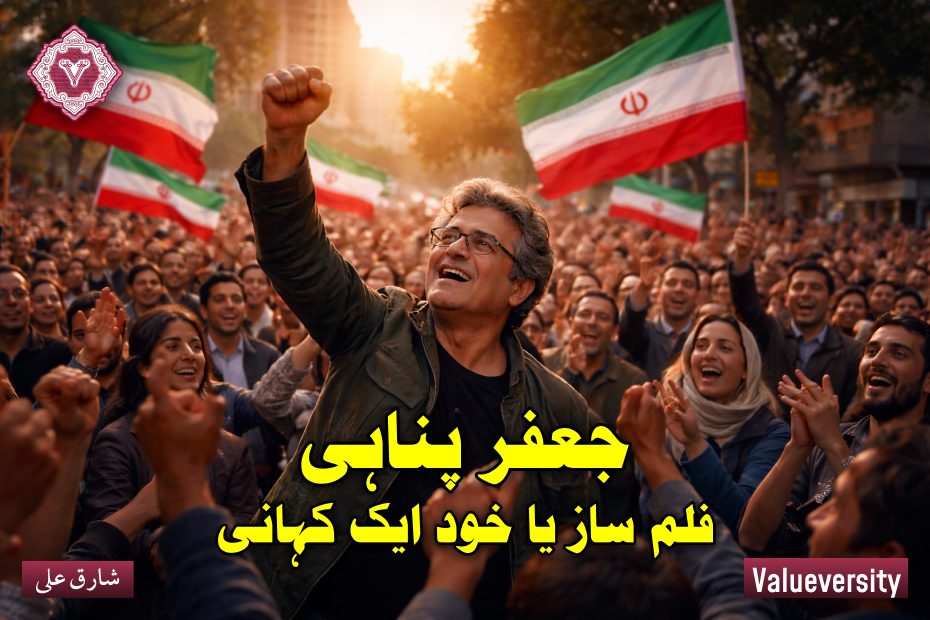
Jafar Panahi — A Filmmaker, or a Story Himself
Shariq Ali
Valueversity
President Trump has already threatened to erase Iranian civilization. In response, Iranian citizens, in large numbers, are pouring into the streets of Tehran, moving in waves to protect power stations and city bridges.
In one of Tehran’s streets, as the crowd surges forward uncontrollably, a voice rises—and suddenly the entire gathering echoes:
“Biya, biya!” (Come, come!)
A thin man, wearing a shy smile, merges quietly into the crowd and disappears within it. This is not a scene from a film—it is the real-life return of Jafar Panahi, the internationally renowned filmmaker, to Tehran.
A filmmaker who has finally returned—not just as a storyteller, but as a living character in the story closest to his heart. A man who walks forward with his life in his hands, stepping beyond the fear of prison and persecution.
Panahi’s life has always remained close to truth. From
The White Balloon to The Circle and Offside, he portrayed the struggles of ordinary people—especially oppressed women—in a constrained society, giving voice to their silent narratives.
But this very truth, this artistic freedom of thought, became his crime. In 2010, he was sentenced to imprisonment and banned from filmmaking for twenty years.
This ban extended beyond cinema—it silenced his voice, restricted his expression, and even forbade him from leaving the country.
Yet for a true filmmaker, distance from storytelling is impossible. One cannot suppress one’s creative essence. During house arrest, he created This Is Not a Film—shot inside his own room, using a simple mobile camera. The film was secretly smuggled out and reached the world, proving that no restriction can truly stop a creator.
Then came another simple yet extraordinary film—Taxi.
In this film,
Panahi himself drives a taxi through the streets of Tehran. Passengers come and go, sharing their stories, and through these encounters, an entire city unfolds. The film becomes a living reflection of Iran’s social, moral, and political realities—layered with profound truth beneath its simplicity.
This film went on to win the prestigious Berlin International Film Festival Golden Bear Award, a testament to its global significance.
And then, one day—everything changes.
The same Panahi, who lived under the shadow of bans, prison, and exile, becomes restless to return to Tehran.
The people for whom he lived—he now wishes to stand with them, even if it means facing death together. Somehow, he manages to leave exile behind and reaches Tehran.
People gather around him in the streets—as if the hero of their story has returned.
The state, once fearful of his voice, withdraws its cases against him. It steps forward and embraces him again. For a moment, it feels as though history has corrected its course—speaking, almost involuntarily, in favor of truth.
This is not just the return of a filmmaker—it is the reclaiming of a civilization. A civilization that cannot be erased or humiliated.
Panahi’s story is no longer unfolding on the screen—it is being filmed on the streets of Tehran, ready for the world to witness.
And when a true artist stands with his people, the ending of the story can only be one thing—
A complete and resounding success.