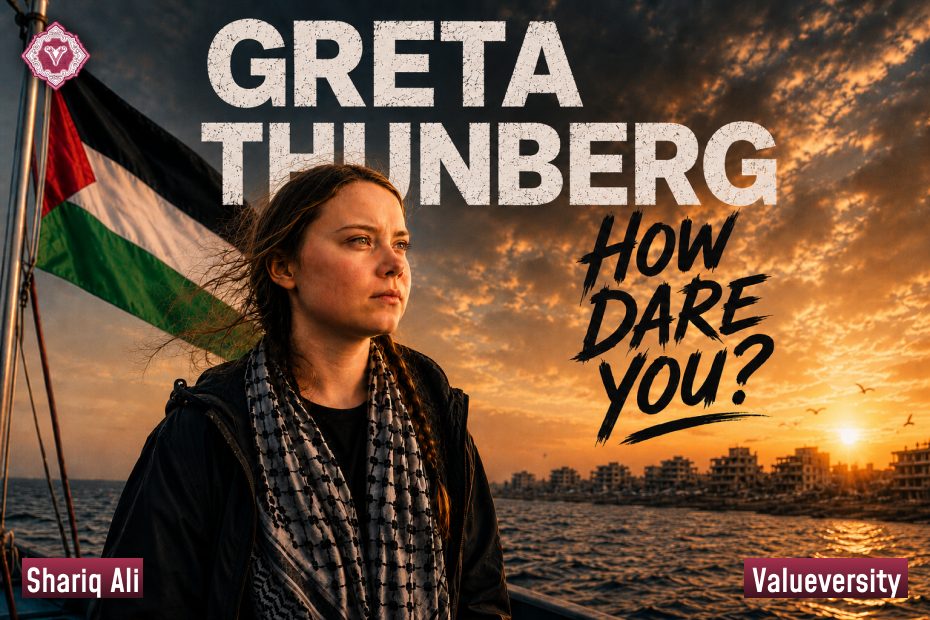
Greta Thunberg
“How Dare You?”
Shariq Ali
Valueversity
The waters of the Mediterranean were relatively calm, but a storm raged in the hearts of those aboard the vessel.
This was not a tourist trip, a commercial voyage, or an adventure at sea. A small flotilla carrying a handful of conscientious people from different countries was making its way toward Gaza.
They had no weapons, no army, and no political power.
What they did have was a conviction: that when human beings anywhere in the world suffer from hunger, fear, and war, the rest of humanity should not remain silent spectators.
Among those on board was a young woman known throughout the world as Greta Thunberg.
If someone were seeing her for the first time, it might be hard to believe that this was the same young woman who, within a few short years, had challenged presidents, prime ministers, industrial leaders, and international institutions to account for their actions. She possessed neither an army, nor wealth, nor a political party. She had only a voice and she refused to let it be silenced.
Greta’s story begins in an ordinary home in Sweden. From an early age, she was deeply sensitive to the world around her.
Global events affected her profoundly. As she began reading about climate change and global warming, one question kept returning to her mind:
“If scientists are warning us, why is the world not listening?”
For her, this was not merely an intellectual debate. It was a question about the future of coming generations.
In 2018, when she was only fifteen years old, she took a step that very few people initially took seriously.
She sat outside the Swedish Parliament holding a placard that read:
“School Strike for Climate Justice”
She was alone, completely alone.
There were no television cameras around her and no crowds gathered nearby. Yet history often begins in quiet moments. At first, people paid little attention.
Then, gradually, they began to notice. Her simplicity, sincerity, and fearlessness inspired young people across the world. Soon, thousands—and then millions—of young people stood beside her. The movement known as Fridays for Future spread across dozens of countries.
Within a few years, she found herself standing on the stage of the United Nations. Before her sat some of the most powerful leaders in the world.
She did not use the language of diplomacy. Instead, she spoke with the passion and anger of a young person who felt betrayed.
“How dare you?”
Those words echoed across the globe.
Some praised her. Others criticized her. But one fact had become undeniable: the world could no longer ignore her.
Over time, Greta’s concerns expanded beyond environmental issues alone. To her, environmental justice was inseparable from human justice. If it was important to speak for the planet, it was equally important to speak for human rights. If the future of coming generations mattered, then the suffering of children trapped in wars and humanitarian crises today mattered just as much.
This belief led her to speak out on behalf of the Palestinian people, particularly children.
Her position was simple: children, regardless of their nationality, religion, or place of birth, deserve protection of their lives and dignity. The burdens of hunger, displacement, and war should not be placed upon their shoulders.
That is why, when the humanitarian flotilla for Gaza was organized, Greta did not limit herself to issuing statements. She chose to become part of the journey herself.
Many people warned her.
Some described it as an unnecessary risk. Others viewed it as involvement in a political controversy. But perhaps Greta’s defining characteristic has always been that she does not see human suffering merely as a news headline.
She sees it as human suffering.
And when a person’s conscience awakens, silence becomes difficult.
Greta’s life teaches us something important.
Many people assume that only the powerful can bring about change. History does not fully support that assumption.
Sometimes, a lawyer stands before the British Empire and becomes known as Mahatma Gandhi.
Sometimes, a young preacher raises his voice against racial injustice and becomes known as Martin Luther King Jr.
Sometimes, a young schoolgirl speaks for the right to education and becomes known as Malala Yousafzai.
And sometimes, a teenage girl sits outside a parliament building, and the world comes to know her as Greta Thunberg.
These individuals differed from one another in countless ways, but they shared one thing in common: they refused to remain silent.
Greta’s supporters and critics both exist, and they probably always will. Yet the most important aspect of her life is not whether everyone agrees with her. What matters is that she inspired millions of young people to believe that a single individual can shake the conscience of the world.
That small vessel sailing across the Mediterranean may not have possessed the power of history’s great naval fleets, but sometimes power is not measured by size. Sometimes, it is measured by purpose.
And perhaps that is the essence of Greta Thunberg’s entire life story.