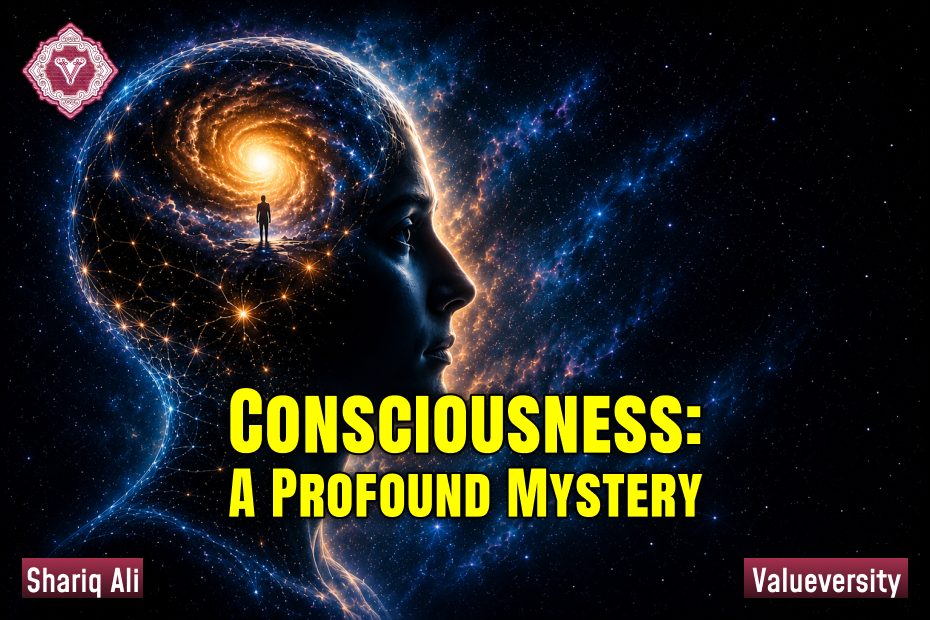
Consciousness: A Profound Mystery
Shariq Ali
Valueversity
Pause for a moment… and look within.
This experience you are having—these thoughts, these feelings—who is it that understands and “knows” all of this?
Who are you?
Are you the one who thinks and feels, or the one who observes yourself thinking and feeling?
It is from this very question that the journey to understand consciousness begins.
In the simplest terms, consciousness is the state in which we not only perceive the world but are also aware that we are perceiving it. It is not merely seeing with the eyes, but the experience of seeing.
Science tells us that the brain is a complex system of billions of cells, where electrical and chemical signals are constantly in motion. Yet a fundamental question arises:
How do these physical processes turn into experience?
This puzzle was termed the “hard problem of consciousness” by David Chalmers—the challenge of explaining how subjective experiences, such as pain, joy, or the perception of color, emerge from brain activity.
Some modern theories attempt to address this mystery. For instance, Integrated Information Theory suggests that consciousness arises where information becomes integrated into a unified whole.
Meanwhile, Global Workspace Theory describes consciousness as a stage where different brain processes come together and become part of our experience.
Some thinkers go even further, asking whether consciousness is merely a product of the brain—or a fundamental property of the universe itself.
All these discussions lead us to a simple yet profound realization:
Everything we know is known through consciousness. We understand the world through it, yet consciousness itself remains beyond our full understanding.
Perhaps consciousness is not a problem to be solved…
but a mystery—one that deepens the more we try to grasp it, always moving just beyond the reach of our comprehension.