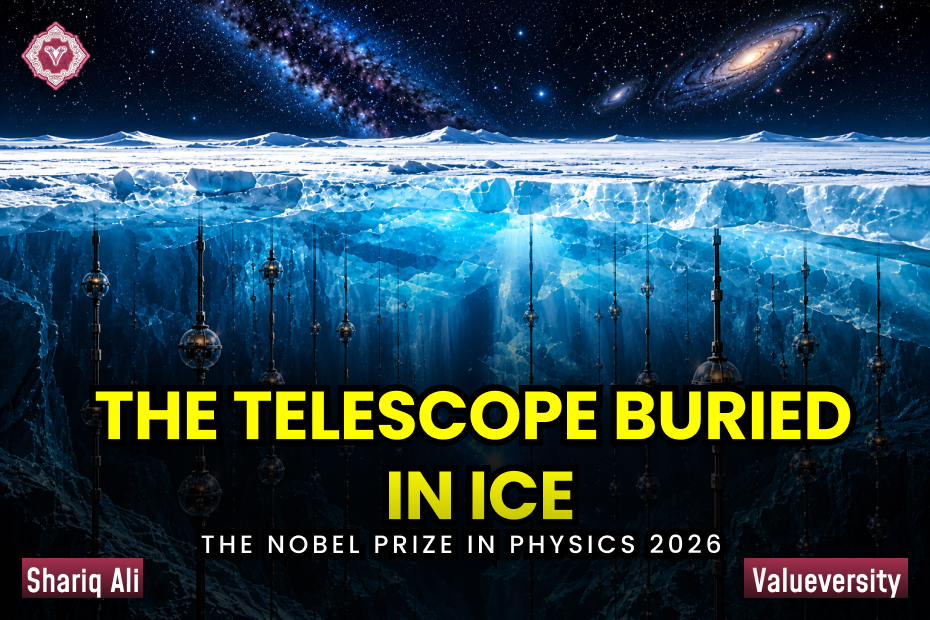
The Telescope Buried in Ice
The Nobel Prize in Physics 2026
Shariq Ali
Valueversity
The snow-covered South Pole. Ice stretching as far as the eye can see. Almost two kilometres beneath this white wilderness, a faint light appears in the darkness. No human eye is there to witness it, but sensitive instruments buried in the ice preserve its trace. It may signal the arrival of a traveller that has reached Earth from a distant corner of the universe. A sealed envelope, perhaps, carrying a message from an unimaginably remote place.
The name of this traveller, or this message, is the neutrino.
To understand it, look at your hand. Hold it against the light and a shadow forms, because your hand blocks the light. Yet vast numbers of neutrinos pass straight through our hands, our bodies, and even the Earth. We feel nothing. These particles interact so rarely with matter that detecting their presence is an extraordinary scientific challenge.
A neutrino is an elementary particle. It has no electric charge, and its mass is extremely small. Some neutrinos are produced in the Sun, others in Earth’s atmosphere. But the neutrinos we are discussing carry very high energies. They can reveal extreme environments in the universe where nature accelerates particles to astonishing energies.
Think of them as messengers from distant events. Like a reporter bringing news from the scene. Or a sealed envelope sent from a faraway settlement, usually remaining unopened along the way. A neutrino, too, passes through most matter on its journey without interacting with it. Its energy and the direction from which it arrives carry clues to its source. If we can detect it, we can, in a sense, open the envelope and read part of the news.
Here, a difficulty also becomes an opportunity. Magnetic fields deflect electrically charged cosmic particles from their paths. The direction from which they arrive does not necessarily point back to their original source. A neutrino is unaffected in this way. Along with the news, it can tell us the direction from which that news has come.
But how do we catch a traveller that can pass through the entire Earth?
Francis Halzen sought the answer in the ice of the South Pole. His idea was to install light-sensitive instruments deep inside clear ice. Occasionally, a neutrino would interact with an atomic nucleus in the ice. The charged particles produced by that interaction would leave a trace of light, and the instruments would record it.
This is called Cherenkov light. It is produced when a charged particle travels through ice faster than light travels through that ice. It does not exceed the speed of light in a vacuum; light travels more slowly in ice.
This idea took shape as IceCube. More than five thousand sensitive instruments were installed within approximately one cubic kilometre of ice. Deep holes were drilled with hot water, the instruments were lowered into them, and the water froze again. The ice itself became part of a magnificent scientific instrument.
An international team of scientists, engineers, and workers laboured for years to turn this dream into reality. Amid the cold and the challenges of delivering supplies, they were building a telescope that did not need to be pointed at the sky.
In 2013, the team presented evidence of 28 events that could not be explained solely by particles produced in Earth’s atmosphere. Then, a neutrino detected in 2017, together with observations from other telescopes, provided evidence identifying a distant active galaxy as its possible source.
Halzen received the 2026 Nobel Prize in Physics for his decisive contributions to this observatory and to the discovery of high-energy cosmic neutrinos.
These sealed envelopes from the universe keep passing through us. Now we are beginning to open a few of them. A faint light preserved in a silent layer of ice can become news of some distant turmoil.