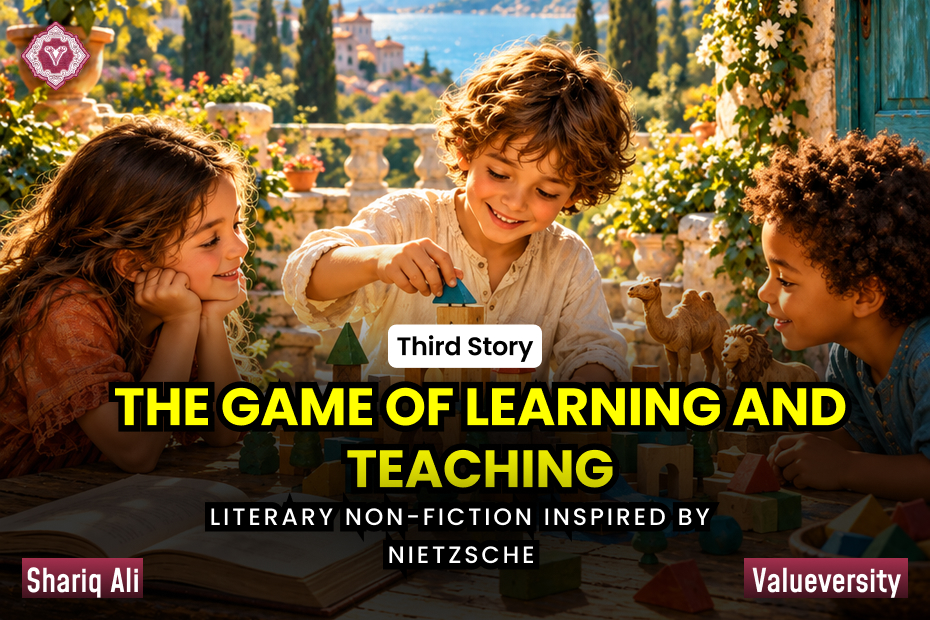
The Game of Learning and Teaching
Literary Non-fiction Inspired by Nietzsche
The Third Story
Shariq Ali
Valueversity
I had been practising medicine for many years. Alongside my professional responsibilities, the desire to read and write about subjects beyond medicine had stayed with me. Literature, philosophy, history, astronomy. There were so many interests and so little time.
Then I took a less demanding job. There, I met a young doctor who also knew how to build websites. When he discovered my interest in reading and writing, he offered to create a website for me.
His offer opened up a new possibility. Whatever I read and came to understand, I could share with others. A place for learning and teaching that anyone, anywhere in the world, could visit.
And so, in 2011, Valueversity began.
What started as a website later extended to YouTube videos and Facebook. Whenever I discovered something new, found a fresh perspective, or experienced the joy of understanding a difficult idea, I wanted to share it. Much as a child, having made something new while playing, calls out to friends: Come and look!
I see this experience in the light of the three transformations of the spirit described in Nietzsche’s Thus Spoke Zarathustra. The camel has the strength to carry burdens. The lion gains freedom by refusing to submit to an imposed command. Yet, for Nietzsche, even the lion cannot create new values. It makes room for that creation. Once freedom has been won, a question remains: What shall we make in this open space?
Here, the child appears.
Nietzsche’s child is a metaphor for innocence, a new beginning, and play. It also possesses the ability to forget: to become free enough of old burdens and constraints to begin something new. After the camel’s endurance and the lion’s courage, the child brings the joy of creation. It says its own yes to life.
As we grow older, we learn a great deal. Yet somewhere along the way, we sometimes lose the freedom to try something new without worrying. Before beginning, we want to know the outcome. Where will this effort lead? What will people say? The child simply begins to play. It makes, takes apart, and makes again. Its joy lies in the process itself.
For me, Valueversity began as just such a small experiment. Writing while learning, and learning while writing. Sometimes an idea became clearer. Sometimes, in trying to write about it, I discovered that I had not yet fully understood it myself. Then I had to return to my reading. The attempt to teach became another reason to learn.
The reader will judge the value of this effort by what they find in it for themselves. Something useful, a new question, or a slightly different way of seeing the world.
Perhaps this is what becoming a child again at some point in life means. To take what we have learned and begin a new game, one that has room for others too.