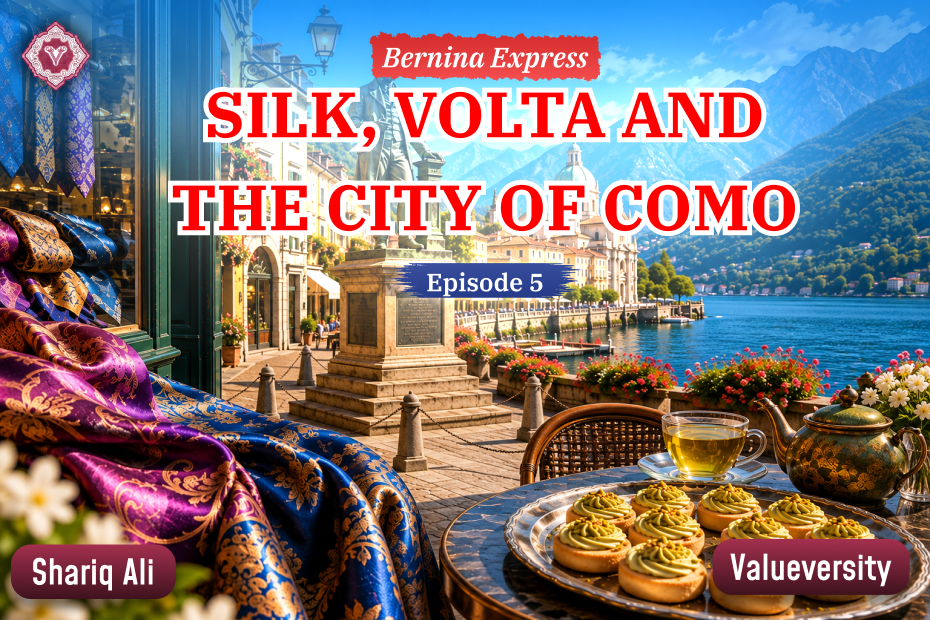
Bernina Express
Episode 5: Silk, Volta and the City of Com
Shariq Ali
Valueversity
The luxury coach arrived right on time at Como’s central coach station, located directly opposite the local police station.
One by one, all the tourists stepped off the coach.
The moment we left the cool, air-conditioned comfort of the coach, we were greeted by the intense June sunshine. The temperature outside was around 30°C. By European standards, this was unusually hot, and the heat was immediately noticeable.
Our tour guide designated a nearby open square as the meeting point and instructed everyone to save its location on their mobile phones to make the return easier.
We then followed our guide on foot towards the historic centre of Como.
Within a few minutes, the modern streets and newer buildings were behind us, and we entered the old quarter of the city.
The narrow streets, paved with ancient stone, seemed to whisper stories from centuries past.
Stone-paved lanes, beautifully preserved centuries-old buildings, historic piazzas adorned with monuments, elegant cafés lining the streets, local shops and residential homes blended together so naturally that it felt as though history and everyday life were breathing side by side.
As we walked, our attention was drawn to several elegant boutiques whose display windows were filled with exquisite silk scarves, ties and beautifully crafted garments.
Our guide explained that Como’s silk industry is renowned not only throughout Italy but across the world for its exceptional quality and craftsmanship.
It felt as though the thousands-of-years-old story of the Silk Road was still alive inside those shop windows.
Centuries ago, raw silk travelled from China and Central Asia to Europe along the great caravan routes of this historic trade network.
Later, after mastering techniques originally learned from China, northern Italy began raising silkworms on mulberry trees, allowing raw silk to be produced locally as well.
The skilled artisans of Como then transformed this raw silk, using extraordinary craftsmanship, creativity and meticulous attention to detail, into elegant fabrics, scarves and ties, gradually establishing the city as Europe’s most respected centre of silk production.
Even today, many of the world’s leading fashion houses rely on the expertise of Como’s craftsmen to produce their finest silk products.
Walking through these ancient streets, one could not help but feel that it was not only the stone buildings that had survived the centuries, but that a living tradition of craftsmanship had endured as well, transforming silk from the East into a symbol of European elegance, beauty and fashion.
Soon afterwards, we arrived outside a beautifully designed modern restaurant.
Neatly arranged tables and chairs stood beneath colourful umbrellas in the open air.
We selected a pleasant table and took our seats.
We ordered green tea along with a few light refreshments.
A few moments later, the waiter returned with our drinks and a plate of beautifully presented biscuits.
The biscuits were delicately decorated with pale green pistachio cream. They looked so elegant that, for a few moments, one almost hesitated to eat them and simply admired their beauty instead.
In Europe, the presentation of food is regarded as an art in itself.
The colours, proportions, choice of tableware and flavours all reflected remarkable refinement.
As we were quietly enjoying the moment, the majestic bells of Como Cathedral suddenly began to ring through the air, their timeless sound having formed part of the city’s daily rhythm for centuries.
After finishing our tea, we paid the bill and once again wandered through the streets of Como, this time making our way towards the lake.
Only a few minutes later, we arrived at a spacious square where a bronze statue, standing proudly upon a tall pedestal, immediately caught our attention.
It was the statue of Como’s greatest son, Alessandro Volta.
Standing before the monument for a few moments, I reflected that some of humanity’s greatest benefactors become so deeply woven into our everyday lives that we often forget even their names, despite the fact that our modern world would be almost unimaginable without their discoveries.
These very streets are the birthplace of the great scientist whose work opened an entirely new chapter in the history of science and technology.
Alessandro Volta was born in Como in 1745.
From an early age, he displayed an extraordinary fascination with nature and science.
After years of research, he created the world’s first practical continuous electric battery, the Voltaic Pile, in 1800.
For the first time, humanity possessed a reliable source of continuous electric current.
Over the following two centuries, countless advances in electricity and electronics were built upon this groundbreaking achievement.
Today’s mobile phones, computers, medical equipment, electric vehicles and countless other modern technologies are all extensions of that remarkable scientific journey.
In recognition of his extraordinary contribution, the unit of electric potential, the volt, was named in his honour.
As we walked on beyond the statue, I found myself wondering whether the young Alessandro had once wandered through these very same streets.
Perhaps it was here that the questions first arose in his mind—questions that would eventually illuminate the world with a new source of energy and understanding.
Perhaps the greatest transformations are always born in peaceful towns and quiet minds.
…To be continued