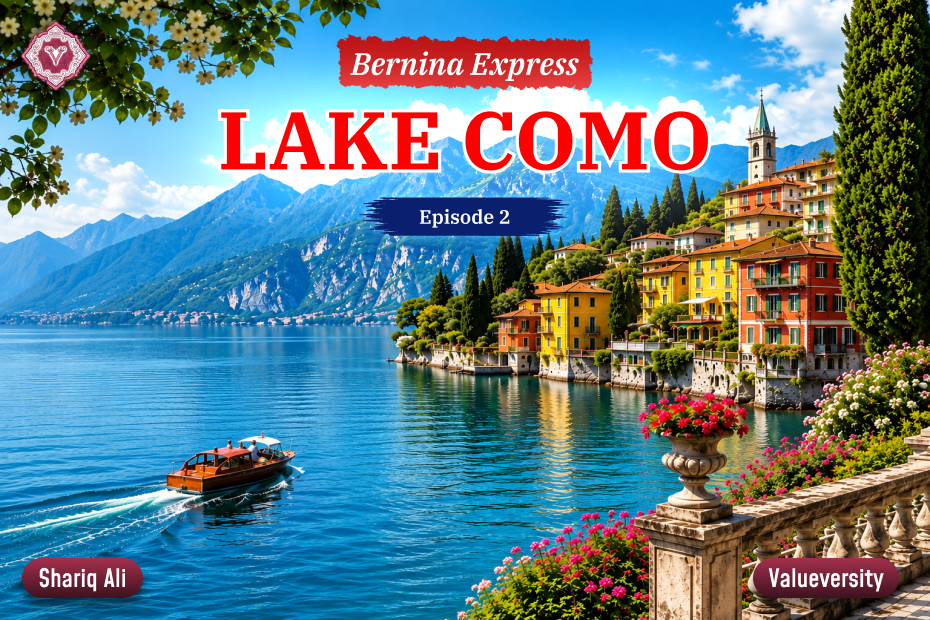
Bernina Express
Episode 2, Lake Como
By Dr Shariq Ali
Valueversity
The morning had barely begun to awaken when the sound of the alarm brought us out of our sleep.
We had a simple breakfast in our hotel room. Tea and coffee-making facilities were available, and we had already purchased a few essential groceries from a nearby store the previous evening.
With everything ready, we prepared for our journey without any rush.
At exactly seven o’clock, the taxi we had booked in advance was waiting for us outside the hotel’s main entrance.
As we stepped out of the reception and settled into the taxi, the quiet Sunday morning of Milan slowly began to reveal itself.
It was Sunday. The streets were unusually peaceful. Only a handful of cars could be seen here and there, while the soft golden sunlight gradually spread across the city’s buildings.
About twenty minutes later, our taxi dropped us at a spacious square behind Milano Centrale Station.
It was a broad open plaza decorated with elegant monuments and stone platforms. Gradually, both tourists and local residents began to fill the area.
Along the roadside stood colourful tourist coaches, each displaying the name of its destination. Some were heading towards the lakes, others to the Alps, while some were bound for Italy’s historic towns.
This was also our designated meeting point.
Since we had arrived a little early, we quietly enjoyed the surroundings.
Before long, travellers from different countries began gathering one by one. Almost everyone carried a mobile phone or camera, a bottle of water, and a light travel bag. Their faces reflected the excitement and anticipation of a new journey.
A few moments later, our tour guide slowly appeared.
She was a slim, middle-aged Italian lady, probably between fifty-five and sixty years old. She walked with a slight limp, had a prominent cross tattoo on her arm, and spoke English with a distinctly Italian accent.
Listening carefully was essential because many words blended so naturally into her Italian pronunciation that they were not immediately easy to understand.
Soon afterwards, our luxury coach arrived.
Its large panoramic windows had been designed to provide passengers with uninterrupted views throughout the journey.
The driver welcomed us warmly and began boarding passengers in an orderly manner.
Since we were among the first to arrive, we had the opportunity to choose our preferred seats. We selected the second row from the front, giving us an excellent view of both the road ahead and the scenery on either side.
A few moments later, the coach gently pulled away.
After passing through several busy roads and intersections of Milan, it joined a wide motorway.
Gradually, the city’s skyline disappeared behind us, and the open highway seemed to invite us into a completely new adventure.
Not long after the motorway journey began, we noticed several small lakes beside the road.
At first glance, we assumed that perhaps Lake Como had already begun.
Our guide smiled and explained that these were not natural lakes but artificial reservoirs built for water storage, hydroelectric power generation, and other practical purposes. They had no connection with the famous Lake Como.
As we continued northwards, our coach entered one tunnel after another, emerging moments later into bright daylight.
Some tunnels were short, while others were so long that it felt as though we were travelling deep inside the mountains themselves.
Passing through these tunnels, I found myself wondering how such magnificent structures could withstand the enormous weight of mountains for decades, even centuries.
At moments like these, human engineering seemed to stand shoulder to shoulder with the overwhelming power of nature.
Northern Italy is internationally renowned for its remarkable tunnel engineering.
Hundreds of tunnels have been carved through the rugged Alpine mountains, connecting regions that were once isolated from one another.
Many have been excavated through solid rock and are equipped with sophisticated ventilation, drainage, and safety systems.
Without them, travel across these mountains would have been far longer and considerably more difficult.
While we were reflecting on this remarkable feat of engineering, our coach entered another relatively long tunnel.
For a few moments, only rows of lights flashed past the windows.
Then, as we emerged into daylight, a breathtaking sight suddenly appeared on our left.
An immense, calm lake stretched into the distance, shimmering in shades of turquoise and sapphire.
Lush green mountains rose almost directly from the water’s edge, while the majestic Alps formed a magnificent backdrop beyond.
Our guide had clearly been waiting for this very moment.
Picking up the microphone with obvious delight, she announced:
“Ladies and gentlemen, on your left is one of the most beautiful lakes in the world—Lake Como.”
Elegant villas hidden among the trees, charming historic villages, and beautiful lakeside residences lined both shores.
For centuries, Lake Como has attracted aristocrats, artists, writers, and travellers from around the world with its extraordinary beauty.
With that unforgettable first glimpse, our journey along the shores of Lake Como had truly begun.
Our coach now followed the winding lakeside road.
On one side stretched the turquoise waters of the lake, while on the other rose steep green mountains reaching almost directly towards the sky.
Every few minutes, the scenery changed, yet each new view seemed even more beautiful than the last.
Although Lake Como is Italy’s third-largest lake, many would place it first in terms of sheer beauty.
It is no ordinary lake but a spectacular natural masterpiece sculpted by glaciers thousands of years ago.
Its distinctive inverted Y-shaped form makes it one of the world’s most recognisable lakes.
Travelling south from the north, the lake divides into two branches: one leading towards the city of Como and the other towards Lecco.
At the point where these branches meet lies the picturesque town of Bellagio.
The northern end of the lake lies not far from the Swiss border, and on clear days the snow-covered Alpine peaks create an unforgettable backdrop.
Since Roman times, Lake Como has remained a favourite retreat for aristocrats, artists, writers, and visitors from across the globe.
After approximately ninety minutes of this delightful drive, our coach finally stopped in a small lakeside town.
From here, the next stage of our journey would continue by water.
We stepped off the coach, formed a queue, and walked towards the harbour, where a large passenger boat was waiting for us.
This was no ordinary boat but a spacious two-deck tourist vessel.
As the afternoon sun had grown quite strong, we chose seats on the lower deck, which featured large glass windows all around.
A small café in the centre served tea, coffee, and light refreshments.
We each ordered a cup of green tea and settled beside the windows.
Around us sat families from many different countries.
As the boat gently glided across the calm waters, the scenery beyond the glass unfolded like a silent film.
Small boats drifted across the lake, verdant mountains embraced the shoreline, and colourful houses with flower-filled gardens created an almost dreamlike landscape.
Before long, a beautiful town slowly appeared on the hillside ahead.
Flower-filled balconies, colourful lakeside buildings, and the tall bell tower of an ancient church could easily be recognised even from a distance.
It was Bellagio—rightly known as “The Pearl of Lake Como.”
Our next destination was Bellagio…
To be continued…