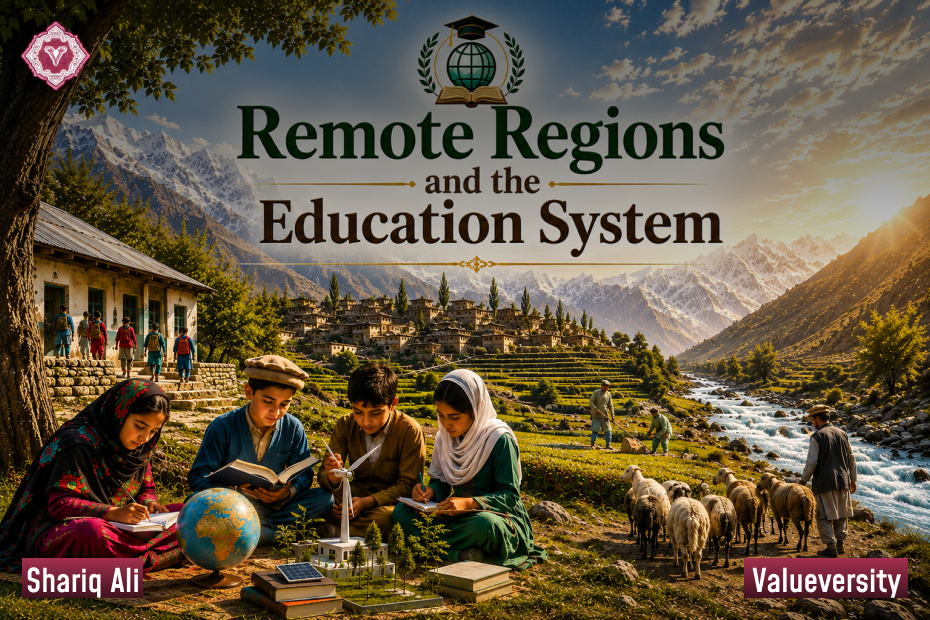
Remote Regions and the Education System
Dr. Shariq Ali
Valueversity
We often assume that a good education system is one that is the same everywhere. In reality, however, the opposite is true. A curriculum that works well for children in a large city may not be equally effective for those living in mountains, deserts, or remote rural communities.
The purpose of education is not merely to teach textbooks; it is to help children understand their surroundings and improve them. If a child’s life revolves around snowy mountains, farms, rivers, or livestock, then their education should also reflect those realities. When learning is connected to a child’s language, culture, and everyday experiences, it becomes both easier and more meaningful.
Such an education system prepares students not simply to pass examinations but to solve real-world problems. They learn to tackle issues such as water scarcity, energy, agriculture, environmental conservation, and the local economy. In doing so, they also develop scientific thinking, mathematical skills, communication, leadership, teamwork, and a sense of responsibility.
Pakistan’s northern regions, Gilgit-Baltistan, Chitral, Azad Kashmir, Balochistan, and many other remote areas have enormous potential for this kind of education. If local needs become part of the curriculum, our schools will no longer be institutions that merely award certificates—they can become centres of community development and innovation.
Perhaps the time has come to ask ourselves an important question once again: Do we simply want our children to succeed in examinations, or do we want them to become architects of their own lives, their communities, and their future?
True education is that which connects people with their environment and equips them not to become part of the problem, but part of the solution.