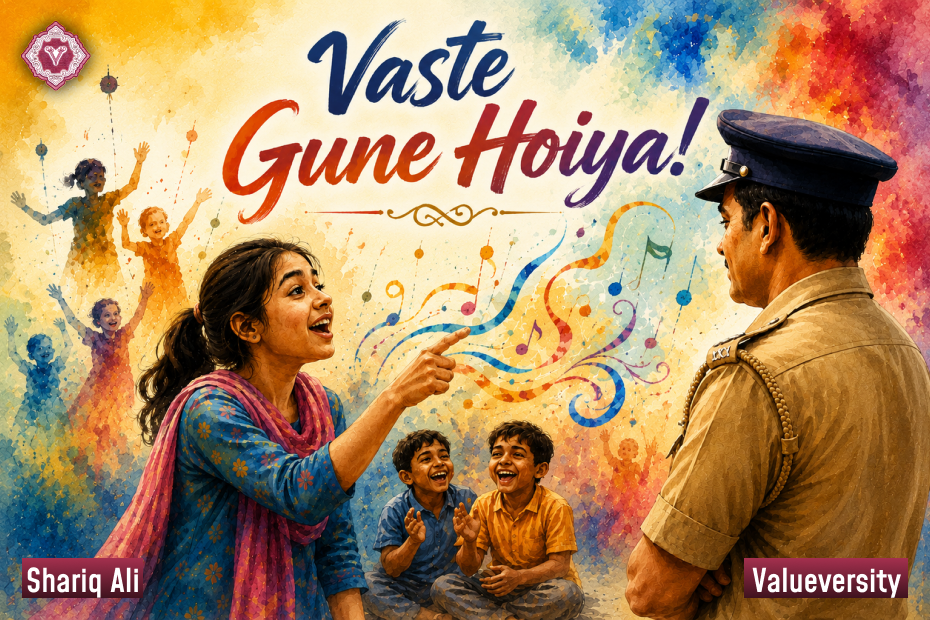
Vaste Gune Hoiya!”
What Does It Actually Mean?
Dr. Shariq Ali
Valueversity
A few days ago, a short video from a protest at Jantar Mantar in New Delhi spread across social media like wildfire. In the clip, a lively young girl suddenly turns to a police officer and blurts out:
“Vaste Gune Hoiya!”
Within hours, the phrase was on the lips of millions. Some people created comedy videos around it, others turned it into songs, countless memes appeared, and thousands searched Google to find out what it meant.
The amusing part—and perhaps the most fascinating aspect of the entire story—is this:
It has no literal meaning at all.
It belongs to a class of expressions known in English as gibberish or nonsense words—phrases that never make it into dictionaries, yet somehow find a permanent place in people’s minds.
But wait…
Is this really something new?
If you grew up speaking Urdu, you’ve probably chanted countless childhood rhymes like:
“Akkar Bakkar Bambay Bo…”
What does that actually mean?
Or what about “Chhoo Mantar!” Which language does that belong to?
In which dictionary will you find “Abra Ka Dabra”?
Or expressions like “Ting Tana Tan,” “Dham Dham Daga Dag,” “Haila Hola,” or “Choon Choon Ka Murabba”?
What do they literally mean?
Perhaps nothing at all—or perhaps everything, depending on the moment and the emotion they carry.
The remarkable thing is that, as children, we never felt the need to ask for their meanings. We didn’t understand them in the literal sense, yet we enjoyed them immensely.
That is one of the marvels of the human mind.
We do not fall in love only with words; we also fall in love with sounds.
Watch two young children playing together. Within minutes, they begin speaking a language that exists in no dictionary:
“Tinga Manga… Tip Tip To… Lolo Baba…”
Yet the other child instantly understands that the game is still on.
At that point, it is not meaning that is communicating—it is connection.
Nor is this unique to Urdu.
English has its own collection of delightful nonsense expressions: Abracadabra, Hocus Pocus, Bibbidi-Bobbidi-Boo, and even the famously long Supercalifragilisticexpialidocious.
Their purpose is not to convey information but to create wonder, rhythm, humour, musicality, and a sense of play.
Linguists suggest that such meaningless-sounding words play an important role in helping children develop language, memory, rhythm, and imagination.
That is why virtually every language on Earth has its own examples.
Perhaps that is also why nonsense words sometimes outlive meaningful ones.
Centuries later, people still sing “Akkar Bakkar Bambay Bo,” while thousands of serious words from the same era have disappeared into the dust of history.
The popularity of “Vaste Gune Hoiya” may have the same explanation.
People were not really searching for its meaning.
They were trying to understand how a seemingly meaningless phrase could bring smiles to millions of faces.
Language is not merely a tool for transmitting information.
It is rhythm.
It is music.
It is culture.
It is play.
And sometimes, it is nothing more than a spontaneous burst of laughter.
Perhaps human beings are the only creatures in the universe capable of discovering meaning, connection, memories, and joy even in sounds that, on the surface, mean absolutely nothing.