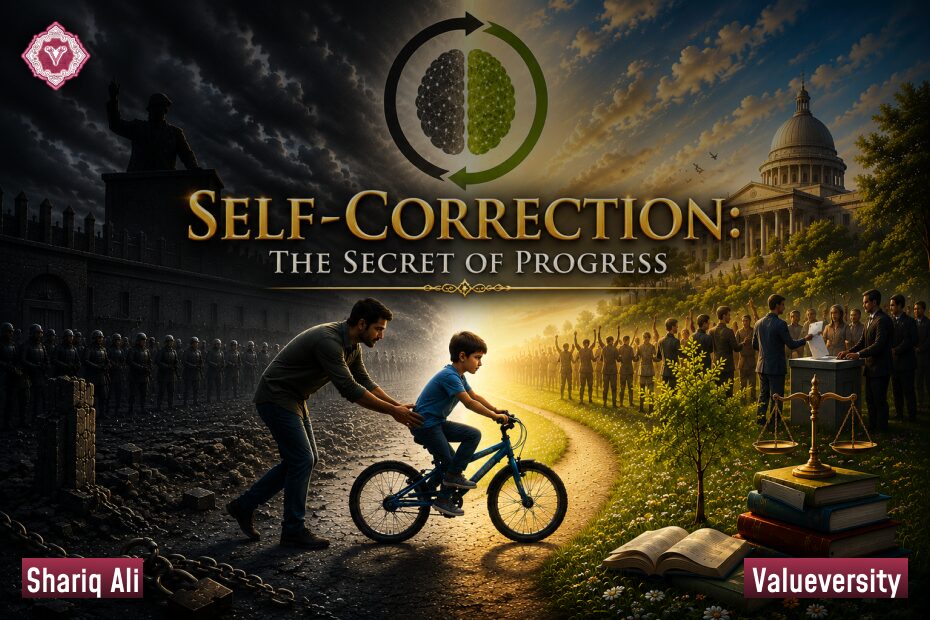
Self-Correction: The Secret of Progress
Dr Shariq Ali
Valueversity
Perhaps the most valuable human ability is not the capacity to never make mistakes, but the ability to recognize our mistakes and correct them.
This process of self-correction is the foundation of both personal and societal progress.
Consider a child learning to ride a bicycle. At first, an older sibling or a friend teaches the child how to hold the handlebars, pedal, and maintain balance. They provide support for only a short while, but the real learning takes place inside the child’s own brain. Each time the bicycle leans too far to the right, the brain makes a slight adjustment to the left on the next attempt.
Another mistake, another correction. After hundreds of tiny errors and equally tiny corrections, one day the child is riding confidently without any support.
Interestingly, our brains operate in much the same way.
Modern neuroscience tells us that the brain is constantly comparing its predictions with reality. Whenever it detects a mismatch, it updates itself and improves its internal model of the world.
This continuous process of self-correction is what enables us to acquire new skills.
The same principle applies not only to individuals but also to societies. Successful societies are those that possess effective mechanisms for identifying and correcting their mistakes.
The true strength of democracy lies not merely in voting, but in its capacity for self-correction.
When governments make poor decisions, citizens can replace them through elections.
Policies can be revised, courts can review decisions, the media and the public can hold those in power accountable, and the entire system has the ability to learn from its mistakes.
In contrast, this capacity is greatly weakened, or even eliminated, under authoritarian rule.
When power becomes concentrated in the hands of one individual or a small elite, institutions lose their independence, the rule of law is no longer applied equally, and there is no genuine mechanism for the peaceful transfer of power. Mistakes accumulate without correction, the door to reform gradually closes, and society slowly moves toward decline.
The same principle is equally important in our personal lives. A person who cannot admit a mistake cannot truly learn anything new. In contrast, someone who regularly re-examines their opinions, decisions, and behaviour becomes a better person with every experience.
The secret of progress is not avoiding mistakes altogether, but improving ourselves after making them.
Nature evolves through this principle. The human brain learns through it. Successful societies flourish because of it. Perhaps that is why self-correction is not merely a good habit—it is one of the defining characteristics of every living and dynamic system.