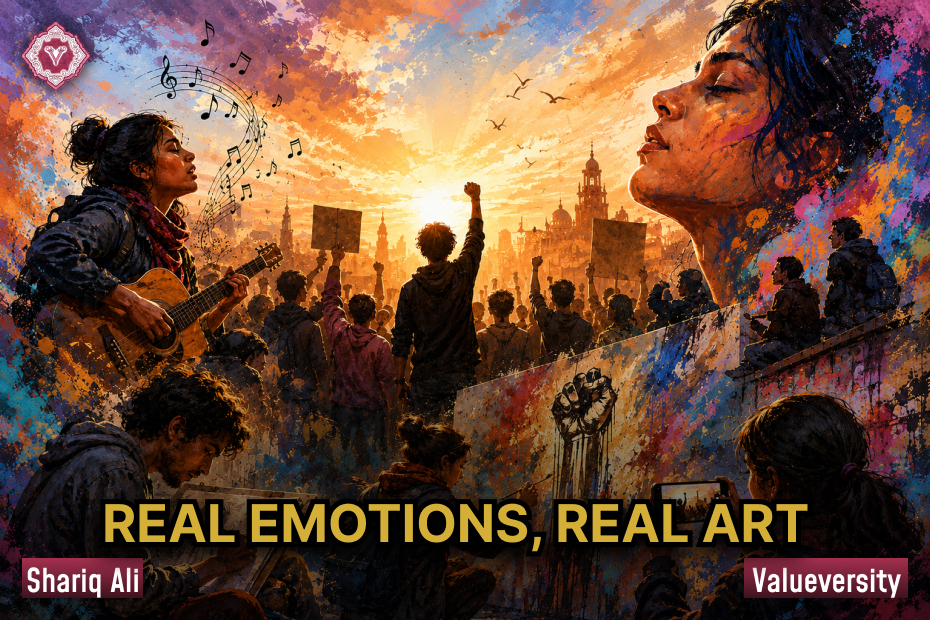
Real Emotions, Real Art
Dr Shariq Ali
Valueversity
Over the past few days, I have become increasingly convinced that genuine art does not always depend on studios, scripts, or expensive productions.
Sometimes it is born in those very moments of human life when people stand shoulder to shoulder in the face of a real challenge, a genuine sorrow, a shared hope, or a common dream. In such moments, emotions are not performed; they are lived with complete sincerity. Perhaps this is where art assumes its most powerful, its purest, and its most authentic form.
Many of humanity’s greatest artistic achievements were not simply the products of royal patronage or professional expertise. Rather, they emerged from the collective expression of human emotions. Protest songs, revolutionary poetry, murals, community theatre, folk music, graffiti art, short films, and public anthems all derive their deepest strength from the reality that breathes behind them.
Today, the world of art has undergone a quiet yet profound transformation.
There was a time when filmmaking required large studios, elaborate sets, expensive cameras, and celebrated actors. Today, even an ordinary smartphone has become a powerful creative tool. A few seconds of video, a simple song, a single photograph, or a handful of heartfelt words can reach millions of people—provided they are driven not by artificial performance but by genuine human feeling.
Viewed through this lens, public gatherings around the world represent a remarkable cultural phenomenon.
From Cairo’s Tahrir Square and Hong Kong’s pro-democracy movements to demonstrations in Chile and France, from Kyiv’s Maidan to the American civil rights movement, and, more recently, New Delhi’s Jantar Mantar, history repeatedly shows that when ordinary people share a common experience, they do far more than chant slogans.
They write poetry, compose new songs, create hand-painted posters, fill walls and placards with their dreams, express themselves through humour and satire, produce short videos and social media reels, and communicate their emotions in ways that speak directly to the human heart.
In such moments, one may see a young musician playing a guitar, groups of students singing together, an artist creating within minutes an image that comes to symbolise an entire era, a short video or an internet meme representing the feelings of millions, or a single silent photograph leaving a deeper impression than a thousand speeches. These are not merely scenes of protest; they are living expressions of humanity’s creative spirit.
The greatest strength of these creations lies not in technical perfection but in their authenticity. A professional actor can shed convincing tears, but a tear that falls from the eyes of someone genuinely experiencing hope, fear, love, injustice, or sacrifice carries a profoundly different emotional weight.
Perhaps this is why art rooted in real human experience often endures far longer than technically flawless productions.
This truth extends well beyond public protests. Natural disasters, international sporting triumphs, humanitarian relief efforts, and moments of collective joy or grief within communities all create circumstances in which human creativity emerges in its most natural form. These expressions eventually become part of the shared memory not only of a nation or a society but of humanity itself.
Perhaps the very definition of art will continue to evolve. The greatest works of the future may no longer be associated with the most expensive sets, the largest productions, or the most famous performers. Instead, they may be defined by the moment when an ordinary person expresses genuine feelings with honesty, courage, and sincerity before the world.
Ultimately, art is not merely about creating beauty. It is about connecting one human being with another. When truth guides expression, sincerity shapes emotion, and humanity gives purpose, an ordinary photograph, a brief video, a simple melody, or a few honest words can become a masterpiece.
Whether in Tahrir Square, Jantar Mantar, Maidan, or any public gathering anywhere in the world, the same lesson emerges time and again: the greatest art is not necessarily what is created beneath studio lights or in front of expensive cameras. It is the art born from lived experience, shared emotion, genuine conviction, and the enduring hope for a better world. Such art transcends its own time and becomes part of the collective memory of future generations.