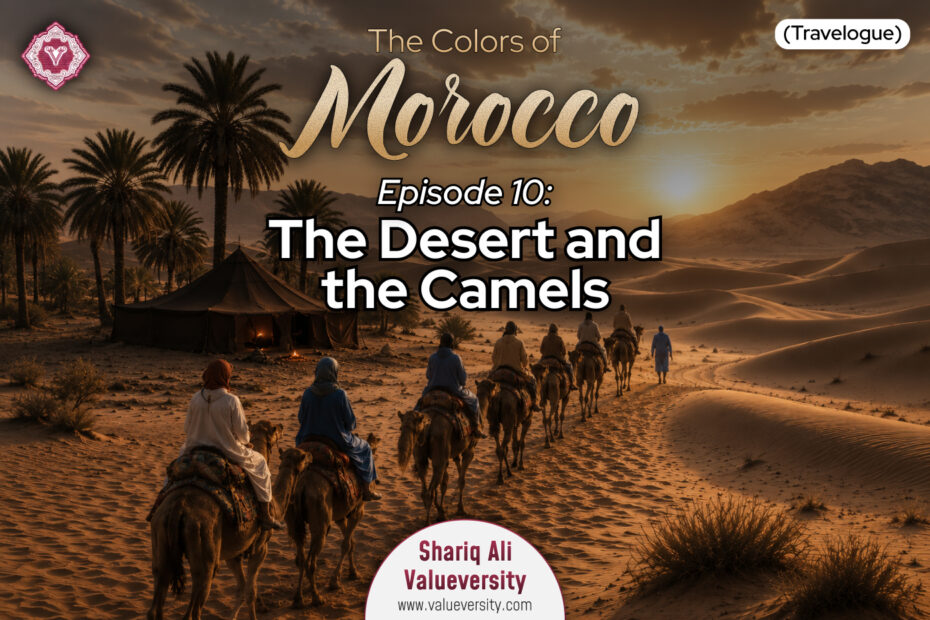
The Desert and the Camels – Episode 10
Colors of Morocco
Shariq Ali
Valueversity
As our return journey began from the cool valleys of Imlil, the mountains slowly started receding behind us. The lush green slopes gradually faded into earthy tones. Before long, the surrounding landscape transformed into a vast, silent desert plain.
Our coach left the main road and moved onto a narrow, trail-like path. After a short while, a large tent standing in the middle of the desert came into view.
Beside this tent stood a long line of camels, tied one after another, waiting for us—like an ancient caravan ready to depart. It felt like a living scene from a centuries-old tale.
As the coach stopped, a few local organizers stepped forward warmly to استقبال the tourists.
Their sun-tanned faces bore the features of desert dwellers—relatively short in stature, dressed in traditional attire, and carrying a distinctive sparkle in their eyes that spoke of genuine welcome. A beautiful blend of Moroccan simplicity, dignity, and hospitality.
Inside the tents, they draped us in traditional Moroccan cloaks—Djellabas—over our Western clothing. Light, loose, and perfectly suited to the desert climate, these garments have been part of the culture here for centuries.
Then began the camel ride. One by one, we were helped onto the camels—some carried two riders, some three, and some just one.
At the signal to move, the seated camels slowly rose—first their hind legs, then the front—giving a gentle, characteristic jolt. It felt as though we had boarded a desert ship, ready to travel back in time, as if time itself had pushed us into the past.
These camels are not merely animals; they are silent companions of the Bedouin desert life. Well-trained, moving in a line, responding to the gestures of their guide. Some had their front legs lightly tied, perhaps to keep them from straying, yet their movement carried a remarkable sense of calm and dignity.
As the caravan moved forward into the desert, the interplay of sunlight and golden sand began, and I felt an intimate connection with a unique face of nature.
In the deserts of Morocco, Bedouin culture is a living tradition that spans centuries.
Here, camels are not just a means of transport but an essential companion of life—vital for travel, trade, and survival in the vast, unforgiving desert.
The camel ride in the Moroccan desert was truly an eye-opening experience. Our guide explained that these are single-humped dromedary camels. Their hump does not store water but fat, which is converted into energy. They can survive for days without water. Their broad, soft feet prevent them from sinking into the sand, and their long eyelashes and closable nostrils protect them during sandstorms—making them perfectly adapted travelers of the desert.
These camels typically live between 40 to 50 years. As calves, they initially feed solely on their mother’s milk, and gradually transition to grazing on grass and shrubs after a few months. Interestingly, their training begins from a very young age so they become accustomed to humans. The desert Bedouins handle them with patience, gentleness, and consistency—because only a well-trained camel becomes a reliable companion for long journeys.
These Moroccan Bedouins live a life in harmony with nature—simple yet dignified. In the modern world, they warmly include tourists in their cultural experience. A camel ride is, in essence, a glimpse into that ancient caravan tradition—where camels, tied in lines, fully trained, and guided by subtle commands, would move silently across the desert.
There is a distinct rhythm and balance to riding them. The Bedouin guides not only manage the entire system with skill but also transform the experience into a cultural memory—through their hospitality, traditional attire like the Djellaba, and the offering of Moroccan tea. Here, one does not merely travel, but truly feels an ancient civilization.
…To be continued