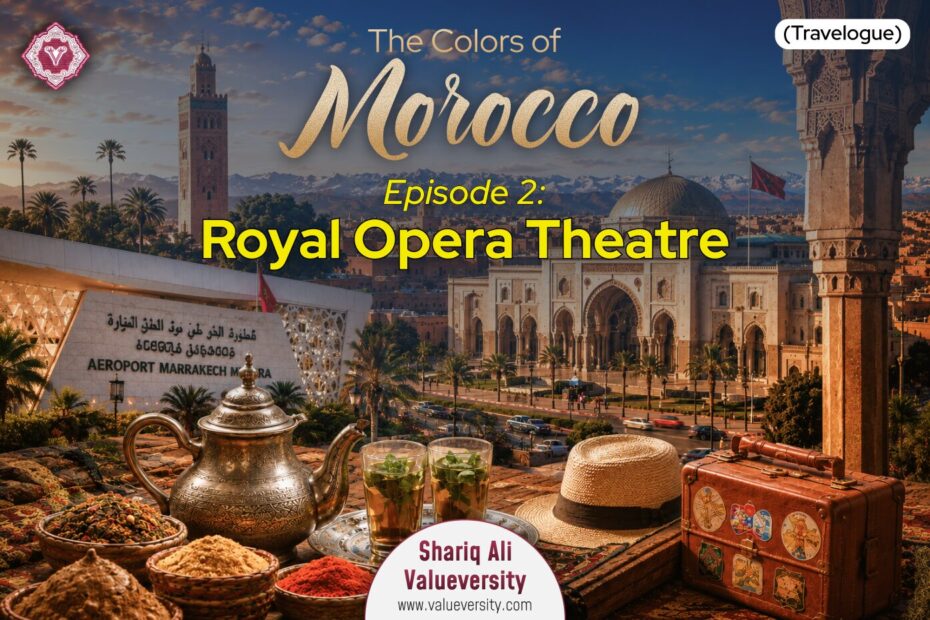
Royal Opera Theatre, Episode Two
The Colors of Morocco (Travelogue)
Shariq Ali
Valueversity
When the plane landed at Marrakesh Menara Airport, it was around ten in the morning. The building carries a somewhat European architectural style, yet here and there one can clearly see gentle traces of Morocco’s traditional culture reflected in its structure and atmosphere. Soft-colored patterns on the walls and windowpanes, high ceilings, spacious halls, and generous use of natural light in the architecture together create the impression that you are standing at the crossroads of Africa, the Arab world, and Europe.
Immigration and passport control were relatively well organized. The staff appeared serious, though somewhat slow-paced. The wait for luggage ended quickly, and after completing the formalities, we stepped into the airport’s open courtyard.
Currency exchange facilities were available inside the airport. We obtained some local currency for immediate needs. Although card payments are widely accepted these days, having some cash felt convenient and reassuring.
Outside, airport taxis were readily available. The local driver was courteous and well acquainted with the hotel. Our luggage was loaded, and we set off toward the city of Marrakesh. The atmosphere of the outskirts, the air, and the constantly changing roadside scenes seemed to whisper that history here breathes through walls, trees, and alleyways.
Traces of human habitation on Moroccan soil are believed to date back at least one hundred thousand years. The original inhabitants of this region were the Amazigh (Berber) tribes, who maintained their distinct identity across mountains, deserts, and coastal areas. Over time, Phoenician, Carthaginian, and later Roman powers arrived here, leaving behind remnants that can still be seen at sites such as Volubilis.
The taxi turned onto Angel Avenue and stopped within the compound of Opera Plaza Hotel.
The staff at the entrance welcomed us with quiet courtesy. Passing through a spacious, modern, and elegant lobby, we reached the reception desk. There was neither excessive grandeur nor unnecessary simplicity—just the calm balance of a four-star hotel. The check-in process was brief: passports checked, a few smiles exchanged, and the room keys were in our hands. The luggage had already been taken to the room by the staff.
Mona liked the hotel. A spacious room, all essential amenities, quiet corridors, a swimming pool, a restaurant, and an overall sense of balanced, dignified, and peaceful comfort.
When we drew back the curtains of the room window, the stately building of the Théâtre Royal de Marrakech stood before us. This is Marrakesh’s modern opera house, yet its design clearly reflects Islamic and Moroccan architectural influences—arched lines, harmonious proportions, and geometric beauty.
The arrival of Islam in the seventh century reshaped Morocco’s culture, language, and social structure. In the centuries that followed, the region came under the influence of various Muslim dynasties. In the modern era, Morocco emerged from French and Spanish colonial rule to gain independence in 1956, thus establishing a unique balance between its ancient identity and a modern nation-state.
This historical backdrop is what lends today’s Morocco its rich cultural colors.
After resting for a while in the room, we decided to head toward Jemaa el-Fnaa. Located at the very heart of the ancient walled city, the Medina, it is a vast and historic square—an emblem of Moroccan culture…. (to be continued).