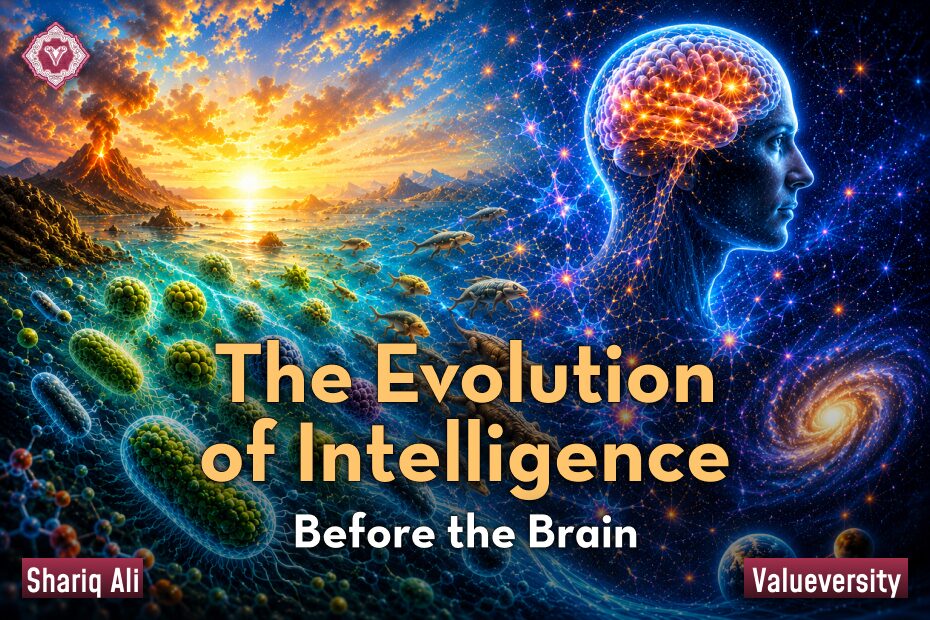
The Evolution of Intelligence
Before the Brain
Shariq Ali
Valueversity
When we hear the word intelligence, we usually think immediately of the human brain, the ability to think, mathematics, language, or complex decision-making. But if we carefully examine the history of life, we realize that the roots of intelligence are far older than the brain itself.
In the earliest stages of life, there was no brain, no nervous system, no eyes, and no ears. Yet the first biological organisms and bacteria were “understanding” their environment for nearly three billion years.
They were deciding which direction to move in and what to avoid — and this was the earliest form of intelligence.
In simple terms, biological intelligence can be understood as the continuous interaction between a living organism and its environment — an interaction that makes survival possible.
Around every organism exist countless signals and stimuli. Some are beneficial, such as nutrients or sources of energy, while others are harmful, such as toxins or dangerous chemicals. The primary purpose of intelligence was to move toward beneficial things and away from harmful ones.
Interestingly, the center of this early intelligence was not the brain, but the cell membrane itself.
Early bacteria used molecular receptors present on their cell membranes to “analyze” their surroundings. By sensing changes in electrolytes and chemical gradients, they could determine where food existed and where danger was present. If nutrients were more abundant in a certain direction, the bacteria would move toward them. If a toxic substance appeared in the environment, they would move away from it. In science, this process is called chemotaxis.
Think about how astonishing this is: billions of years ago, a microscopic organism without a brain was already “making decisions.” It was gathering information, processing it, and responding in ways that helped preserve its existence. That, in essence, is the fundamental spirit of intelligence.
Over time, this simple biological intelligence evolved further.
Communication networks developed between cells, nervous systems emerged, and eventually the brain came into existence. The human brain is, in fact, the most advanced stage of this long evolutionary journey.
Seen from this perspective, intelligence is not merely about IQ or academic knowledge. It is the ability of life itself to understand the environment and improve the chances of survival.
Perhaps that is why the story of intelligence in the universe does not begin with humans, but with a remarkably simple microscopic cell.