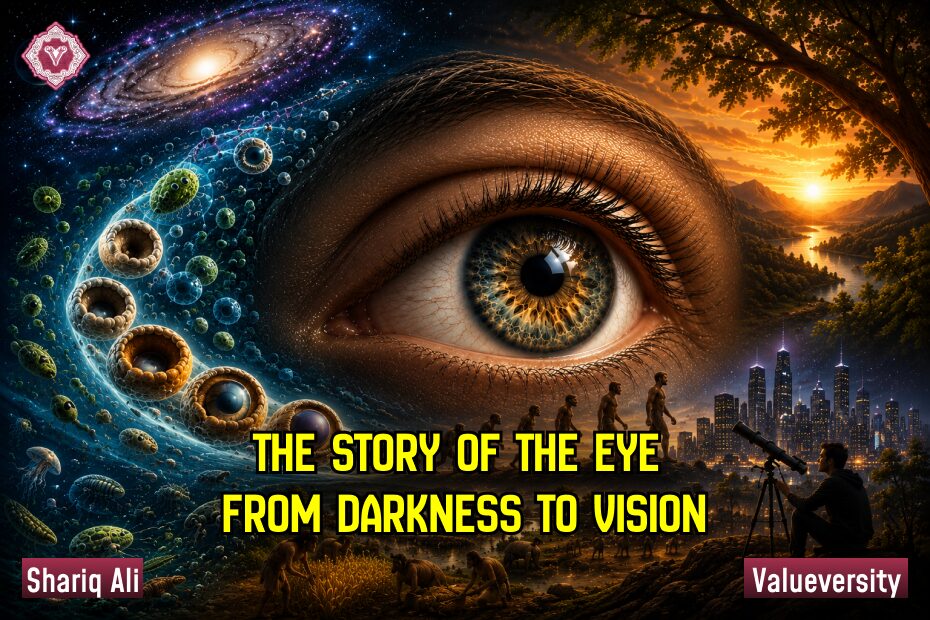
The Story of the Eye
From Darkness to Vision
Shariq Ali
Valueversity
Look around you…
Everywhere, colors are scattered across the world.
The blue sky, the lush green trees, the changing expressions on human faces, the words written in books, the golden beauty of sunsets, and the glittering cities that come alive at night…
All of these things hold meaning for us because we can see them.
But did you know that for nearly the first three billion years of life on Earth, nothing like “seeing” even existed?
The world existed…
Light existed…
Colors existed…
But there was no eye to witness them.
Yes—none at all.
During that immense span of time, Earth was inhabited by microbes, bacteria, and simple organisms, but none possessed anything resembling vision or an eye.
The sun would rise, light would spread across the oceans, the seas would shimmer—yet nowhere in the universe was there a living being capable of truly “seeing” these scenes.
Then evolution began an extraordinary journey.
This story begins with a tiny protein that scientists call opsin.
It was a molecule capable of reacting when particles of light—photons—struck it.
At first, it could only sense one simple thing: whether there was light or darkness.
Nothing more.
This was not vision.
It was merely light sensing.
But in the grand evolutionary journey of nature, that tiny step continued to develop, and after millions upon millions of years, it eventually led to eyes, vision, colors, images, films, telescopes, and ultimately the vibrant visual world of human civilization.
Early organisms may have merely moved toward light or away from darkness.
Later, dark pigment-like substances began collecting in certain cells.
This allowed organisms to sense the direction from which light was coming.
For the first time, direction sensing had emerged.
Then evolution produced another astonishing transformation.
The light-sensitive, opsin-rich cells gradually folded inward, like a small dent forming in a ball.
Now the organism could vaguely detect whether something existed in front of it or not.
This was the primitive eye.
Millions of years later, the opening of this pit became smaller, much like a pinhole camera.
Blurry images could now begin to form.
Then came yet another remarkable leap.
Certain transparent proteins accumulated and gradually formed a lens.
Light could now be focused more effectively.
The image became clearer.
And thus, the first true eye came into existence.
Later, copies of opsin genes continued to evolve.
Each new copy became sensitive to different wavelengths of light.
One detected blue,
another green,
and another red.
And so, the world of color was born.
Just imagine…
There was once a time when the sky was not “blue,” and trees were not “green,” because colors only have meaning when a conscious being can perceive them.
Evolution did not merely create the eye…
It created the very act of seeing the universe.
And perhaps that is the most astonishing part of this entire story.
Light had existed in the cosmos for billions of years, but there was no one to witness it.
Then, a tiny opsin molecule took the first small step in evolution’s journey—a step that ultimately enabled human beings to gaze at the stars, create art, write books, build telescopes, and even understand the story of their own eyes.
Truly…
it is an extraordinary story.