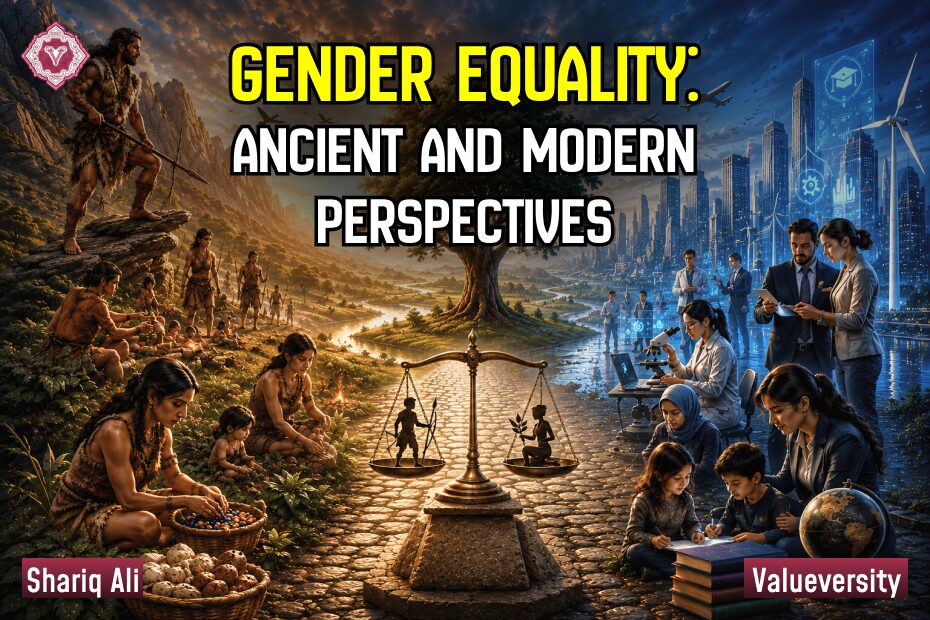
Gender Equality:
Ancient and Modern Perspectives
Shariq Ali
Valueversity
Thousands of years ago, during the early evolutionary age، when there were no cities, no land registries, no bank accounts, and no modern social structures۔ Human beings lived in small groups scattered across forests, plains, and riverbanks.
This was the era anthropologists describe as the Hunter-Gatherer Society.
In those times, men generally went out hunting. Sometimes they hunted deer, sometimes wild goats, and sometimes they returned empty-handed for days.
Hunting was dangerous and uncertain. But when it succeeded, the entire tribe benefited: meat provided protein, fulfilled nutritional needs, and contributed to physical strength.
Women, on the other hand, were not merely “creatures sitting at home,” as many later civilizations came to imagine—and some societies even began to regard that notion as a natural, religious, and eternal truth. Women gathered wild fruits, roots, seeds, honey, and vegetables. They preserved food, dried it, distributed it, and taught children which plants were poisonous and which were beneficial.
Interestingly, modern research suggests that in many ancient communities, a significant portion of daily food actually came from these gathered foods rather than from hunting. In other words, women were not simply “helpers”; they were a central pillar of the food economy.
The famous zoologist and writer Desmond Morris discussed this point in his writings, explaining that although the roles of men and women in early human societies were different, their importance was relatively balanced. Power was not concentrated in one gender alone; survival depended on the cooperation of both.
Even today, when anthropologists study hunter-gatherer communities such as the !Kung San of Africa, the Hadza of Tanzania, and other traditional tribes, it is striking to observe that women often enjoy comparatively greater freedom, social respect, and participation in decision-making. In many such societies, decisions are made collectively, and food distribution tends to be more equal.
Then came a great revolution:
Agriculture.
For the first time, humans began to establish permanent control over land. Fields were cultivated, grain was stored, and livestock accumulated.
The challenge was no longer merely producing food—it became protecting property.
And this was where the social balance of human history gradually began to change.
Land, power, and warfare became deeply interconnected.
Physical strength grew increasingly important. Men, who had once primarily been hunters, now became protectors of land, livestock, and resources. Gradually, concepts such as inheritance, lineage, family ownership, and property pushed women more toward the domestic sphere—toward child-rearing and the inner household domain.
This transformation did not happen suddenly. It slowly seeped into civilization over thousands of years.
What is fascinating is that today, the modern world appears to be completing a strange historical circle. In the age of knowledge, technology, and the digital economy, physical strength is becoming less important, while intellectual, creative, and social abilities are becoming increasingly valuable.
Perhaps that is why humanity is once again returning to an old question:
Was the true strength of human beings always rooted in cooperation rather than domination?
And perhaps civilization’s greatest misunderstanding was that it confused “difference” with “superiority.”