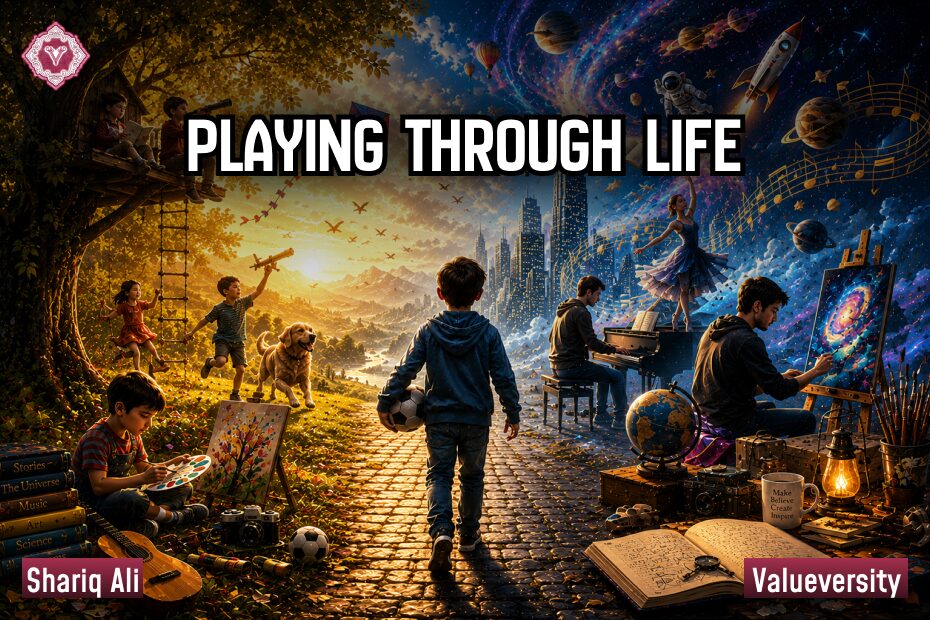
Playing Through Life
Shariq Ali
Valueversity
British zoologist and renowned author Desmond Morris, in his famous book The Naked Ape, tried to explain human behavior through the lens of animal evolution. In his later writings and research, he also highlighted a fascinating idea:
Many animals play during childhood, but human beings are perhaps the only creatures who continue to “play” throughout their entire lives.
If you ever watch young chimpanzees, you will notice that they jump around, tease one another, and learn through play—much like human children. Baby elephants also splash in water, run around, and engage in playful mischief. But as these animals grow older, life becomes increasingly serious for them. Their focus narrows mainly to food, safety, power, and survival.
But humans?
Humans never truly stop playing.
Only the form of play changes.
The ball of childhood eventually becomes a football stadium.
The sounds of toys evolve into music and orchestras.
Childhood drawings transform into painting and art galleries.
Simple body movements become dance.
And the love of listening to stories gives birth to novels, films, and theatre.
According to Desmond Morris, this unique quality is connected to the idea of “neoteny”—the ability to retain certain childhood traits throughout life. Human beings preserve not only physical but also psychological aspects of childhood.
Perhaps this is why humans remain curious, continue asking questions, create new ideas, and imagine entirely new worlds.
Just think…
If humans had stopped playing, perhaps music would never have existed, poetry would never have been written, films would never have been made, and science might never have advanced so far.
Because play is not merely entertainment.
Play is the earliest form of creativity.
And perhaps humanity’s greatest strength is that humans do not live merely to survive…
They also live to feel, to understand, and to make life beautiful.