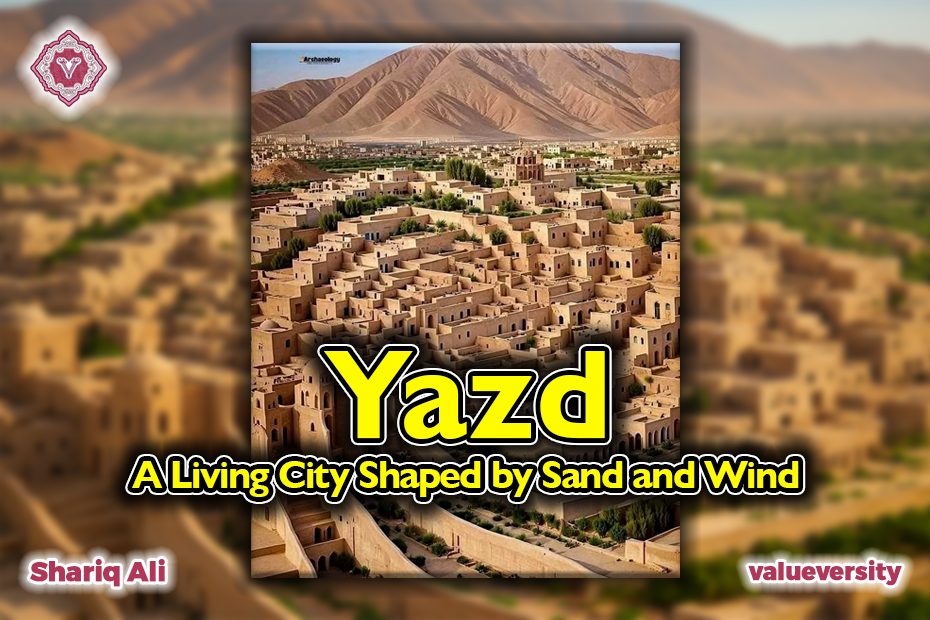
Yazd — A Living City Shaped by Sand and Wind
Shariq Ali
Valueversity
Along the edge of Iran’s central desert, under the shadow of the Zagros Mountains, lies a city that for centuries has embodied human ingenuity, respect for nature, and the struggle for survival. This is Yazd—the ancient settlement of mud-brick architecture the world lovingly calls the city of windcatchers.
At first glance, Yazd appears as if it were sculpted from sand and sunlight. Its lanes are narrow yet airy, the walls coated with warm, golden mud plaster, and on every rooftop stands a tall windcatcher—that tower designed thousands of years ago to capture and cool the desert breeze, humanity’s earliest form of air-conditioning.
There is a quiet music breathing through Yazd’s atmosphere. When the harsh afternoon sun strikes the clay walls, the shade of courtyard plants and the coolness rising from deep wells offer relief and freshness. The thick walls absorb the day’s heat and release it back as soothing coolness at night.
Yazd is not merely a historical site; it is a living lesson in how to coexist harmoniously with nature. The narrow alleys cast protective shade from the fierce sun, the courtyards serve as the heart of each home—cool, peaceful, inviting—and the windcatchers welcome every passing breeze with gentle respect.
Beneath the city runs a web of qanats—underground water channels—that turned Yazd into an oasis in the desert. Water travels silently from distant mountains, gathering in the city’s reservoirs before flowing to homes, mosques, and gardens.
By evening, when the sun casts its final golden rays on the yellow-tinted bricks, Yazd resembles a dream carved in light. Every corner reflects human creativity, harmony with the environment, and a culture built on patience and contentment.
Yazd reminds us that long before the age of modern machines, humanity already knew how to live beautifully and wisely by understanding the laws of nature.
It is not just a city.
It is the consciousness of the desert, the wisdom of clay, and a civilization written in the language of the wind.