William Osler: The Patient’s Bedside and Medical Education
Shariq Ali
Valueversity
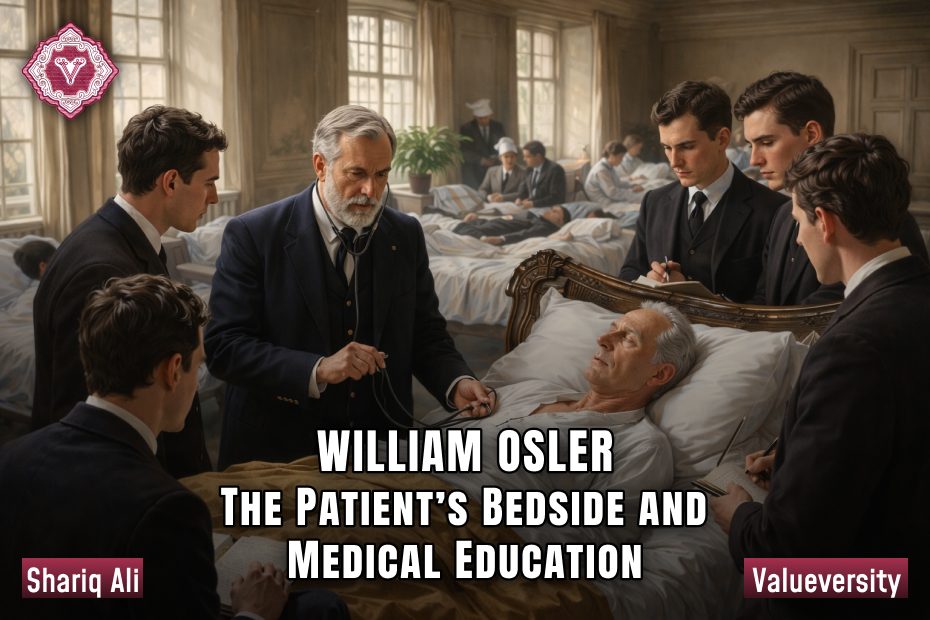
In a hospital ward in Baltimore, a group of medical students stood around their teacher. The professor gently closed the thick medical textbook lying on the table and said with a smile:
“Today, we will not learn from the book—we will learn from the patient.”
He then led the students to a patient’s bedside and explained that the best way to understand disease is to observe the patient, listen carefully to their story, examine them, and then discuss the findings with the teacher.
This teacher was William Osler, the physician who introduced a new approach to medical education that we now call bedside teaching.
William Osler was born in Canada in 1849. In those days, medical education in colleges was mostly limited to textbooks and lectures. Students learned a great deal about diseases from books, but they had very few opportunities to learn directly from patients.
Osler changed this method. He believed that medicine is truly learned at the patient’s bedside. He began taking medical students into hospital wards, encouraging them to listen to patients’ complaints, examine them carefully, and present their observations for discussion with their teachers.
The modern system of clinical rotations and ward teaching practiced in medical schools around the world today is rooted in this very idea.
In 1892, Osler also wrote a famous book titled The Principles and Practice of Medicine, which served as a fundamental guide for doctors for many decades.
Yet his teaching was not limited to medical science alone.
He often said:
“A good doctor treats the disease, but a great doctor treats the patient who has the disease.”
This philosophy transformed medicine from merely a science into a humanistic art, and for this reason William Osler is still regarded as one of the architects of modern clinical medical education.