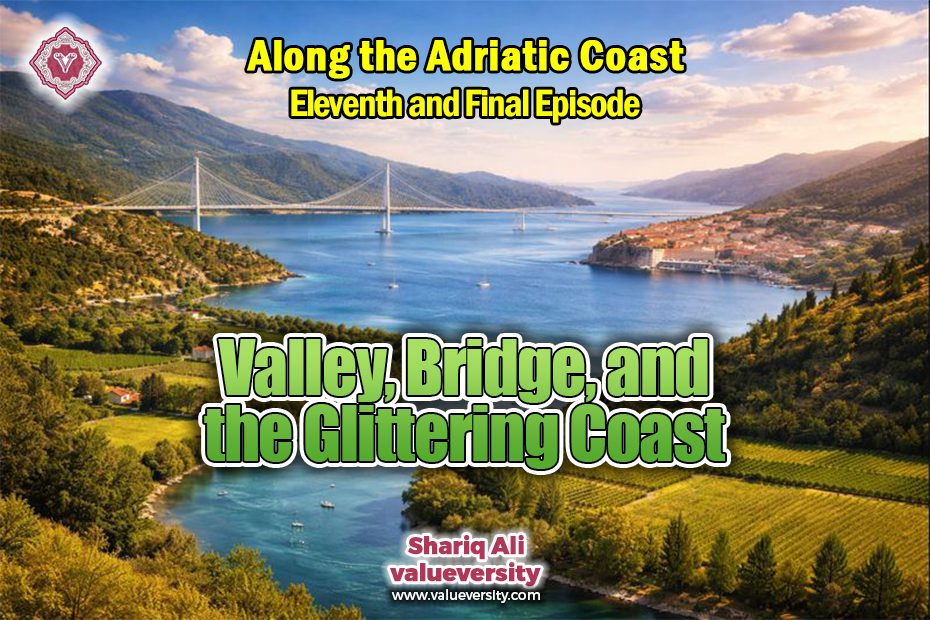
Valley, Bridge, and the Glittering Coast: Along the Adriatic coast,
Eleventh and Final Episode
Shariq Ali
Valueversity
Leaving Kravica National Park behind, our coach was now heading toward Dubrovnik. Passing through winding roads among low hills, we entered a vast valley of the Trebižat River—an entirely flat plain, as expansive as forty or fifty hockey grounds combined, with a river flowing right through its heart. Despite being encircled by hills, the valley was astonishingly level, as if nature itself had laid out a carpet of lush green fields. The river ran in a straight line through the crops, tall trees standing silently along its banks like vigilant guardians. Gentle hills cradled this flat land in their embrace.
Spring was at its peak: crops were lush and ready for harvest, trees swayed with life, and the post-rain moisture infused the air with freshness. When the valley ended and the coach began climbing back to higher ground, I turned to look at the valley as it receded through the window. The vast landscape stretching below felt complete in itself—
a fusion of spiritual calm, natural fertility, and quiet beauty.
Among Bosnia’s rivers, the Neretva and the Buna not only irrigate the land but also define the agrarian life along their banks. Flowing between mountains and towns, the Neretva breathes life into the fields. Around Mostar, farmers begin their work early in the morning—growing maize, vegetables, grapes, and in some places, tobacco. With simple homes, small gardens, and livestock, a self-sufficient yet quietly dignified life continues its steady rhythm.
The Buna River, emerging suddenly from the foot of a mountain near Blagaj, is small in size but rich in beauty. Crystal-clear waters, a few riverside cafés, wooden boats, and the calm presence of people together create a world where time seems to slow down.
Life along riverbanks is perhaps the same everywhere—simple, hardworking, and deeply connected to the land. Here, time is measured by the changing seasons, and life flows not with noise, but with the current.
Soon our coach stopped at the Bosnia–Croatia border. The guide collected our passports in a box and entered the checkpoint building. Within minutes, the stamps were done, and we had re-entered Croatia.
Now the coach moved toward Dubrovnik, and the scenery gradually drew closer to the Adriatic coast. Before long, we were traveling across the Pelješac Bridge. First seen from a distance, and then experienced up close, this masterpiece of modern engineering revealed itself in full grandeur.
Suspended over the blue expanse of the Adriatic Sea, the bridge is not merely a passageway but a symbol of freedom of movement for Croatia. The quiet sea below, distant blue outlines of mountains, and the fading daylight together created a strange and gentle intoxication.
By the time we reached Dubrovnik, the night was alive with activity. The coach wound through different routes, dropping tourists at their hotels, and then headed toward our accommodation. Along the coast, the dining halls of cruise ships sparkled with light, private boats glided across the water, and the illuminated shoreline had become a living painting.
In a short while, the coach will drop us off and depart.
This is our final night along the Adriatic coast.
Tomorrow, we return—
but the valleys, rivers, bridges, and shores
will now travel with us.
The End