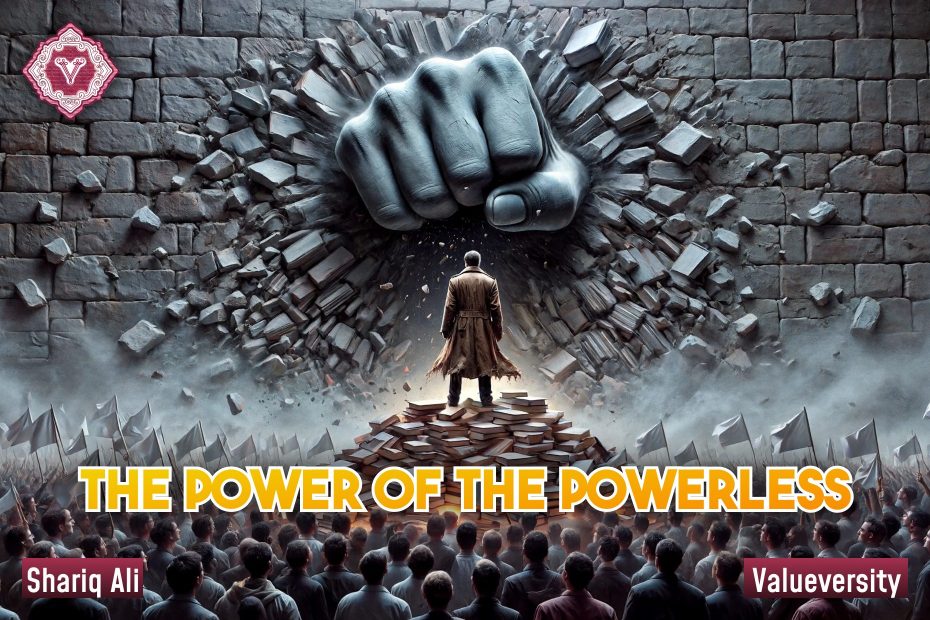
“The Power of the Powerless”
Shariq Ali
Valueversity
Václav Havel was among those rare intellectuals of the twentieth century who were tested in all three arenas: the pen, the conscience, and politics. By profession he was a playwright and essayist, yet history did not allow him to remain only a man of letters. Under the long shadow of communist repression, he spoke what was forbidden to be spoken—and later, the very same man became the president of his country. This paradox itself is proof of the truthfulness of his thought.
Havel’s famous essay “The Power of the Powerless” was written in 1978, at a time when the communist system in Eastern Europe, despite its outward stability, had become hollow from within. It was an era in which the state functioned not so much through brute force as through ritualized obedience: slogans, posters, statements, and silent consent. People mimicked belief without actually believing—simply because “going along with the system” felt safe.
In this context, Havel offers a simple yet profound example: a greengrocer places a poster outside his shop that reads, “Workers of the world, unite!” He does not believe in the slogan, yet he displays it anyway. The poster is not an expression of faith; it is a certificate of obedience.
According to Havel, it is precisely these small, everyday lies that together keep a large oppressive system alive. In contrast, he proposes the idea of “living in truth”—that is, refusing to participate in the daily rituals of falsehood.
In today’s global context, this essay has become strikingly relevant. Concepts such as the “rules-based world order,” “universal law,” and “equality of all nations” exist eloquently in rhetoric, yet in practice they shift with the balance of power. One superpower fails to claim moral superiority over another, and principles appear subordinate to interests. At such a moment, Havel reminds us that real change does not come from the top. It comes when ordinary people refuse to accept the lies of double standards. That, indeed, is the true power of the powerless.