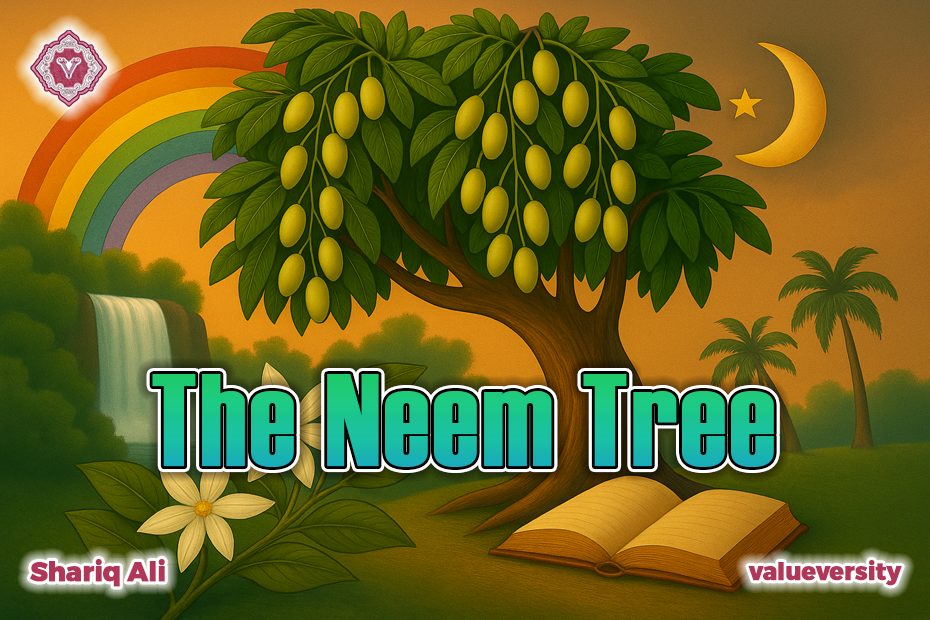
🌿 The Neem Tree
By Shariq Ali
Valueversity
You must have seen a rainbow rising shyly from the edge of the sky after a heavy rain has stilled.
You must have gathered jasmine blossoms, placed them on your palm, and breathed in their trembling fragrance.
You must have stood near a plunging waterfall and felt its cool breath on your face.
Perhaps you, too, have whispered to the moon as it played hide and seek behind the palm leaves.
Such was Yani Apa — made of the same delicate enchantments.
The November sun was gentle but warm enough.
I asked the driver to wait, promising to return in half an hour, and stepped into the narrow lane on foot.
There was an eleven-year-old boy I had come to meet — and a secret he had kept buried in his heart.
After a short walk, I found myself standing before a neatly restored house.
I looked at it for a long time.
It was Yani Apa’s ancestral home — refurbished in a modern way, yet its bones still held the grace of the old days.
She no longer lived there.
Next to it stood my own house — fifty years old now.
Most likely entangled in some legal dispute, it had been sealed.
Paint peeled from the walls.
The flowerbeds were bare — no flowers, no green, no life.
And yet, to my astonishment and relief, my confidant of childhood — the neem tree — still stood there, smiling in its quiet, leafy way.
Taller now. Stronger.
The silent guardian of my boyhood dreams.
By then, books had already become my addiction.
Once I exhausted every children’s book at Ferozsons, I wandered further — into Nasser Kazmi’s Diwan and Faiz’s Dast-e-Saba.
Some verses I understood, most I didn’t.
But reading soothed me in a way nothing else did.
That neem tree in our outer lawn grew straight for six or seven feet and then curved gracefully, as if nature had sculpted a cradle just for me.
My small body fit into that curve perfectly, half-reclined, hidden from the world.
I climbed so fast that within seconds I was in my secret perch.
Thick leaves and clusters of lilac-green fruit hid me completely.
No one could find me.
If I was gone too long, the house would erupt in alarm.
My elder brothers searched the lawn and the street.
I lay silent among the leaves, watching them from above.
When the time felt right, I climbed down and invented some harmless lie.
That tree was my den — my creative cave, my private universe.
I read the entire Tarzan series sitting there, suspended between earth and sky.
Every now and then, I peeked over into Yani Apa’s lawn.
If the small window of her room was open, I knew she was home.
She must have been twenty-one or twenty-two then —
A third-year medical student.
A lover of books.
On pleasant days, she lay half-reclined on an easy chair in the lawn, a book in her hand, drifting softly through the hours.
Loose, colourful, modern clothes.
Eyes the colour of green glass.
Semi-rimless spectacles.
And behind them, a quiet, perpetual smile.
Books were the bridge between us.
Two or three times a month, I cycled to Ferozsons with a small list of English titles she gave me — and money folded neatly in my pocket.
Finding her book made me feel strangely important.
Sometimes she ordered her favourite dark chocolates, “Pixies,” from Benduqwala Bakery.
She always gave me a little extra to buy something for myself.
I was a skilled cyclist; the responsibility suited me.
When I returned, I parked my bicycle in her lawn and she seated me in the cosy sitting room next to her bedroom.
She prepared a Marmite sandwich for me with her own hands.
Soft Frank Sinatra played on the turntable.
She savoured her chocolate; I enjoyed my sandwich.
We talked.
We laughed.
Her short, neatly cropped hair and earrings trembled every time she giggled.
It made the entire room feel lighter.
I was not fond of her friends.
When they came, she disappeared for hours, and I waited — impatiently, silently.
Her family, too, treated me with great affection.
Her elder brother admired my skill in handling a kite reel.
With her younger brother, I exchanged storybooks.
Her father — whom everyone called Udaasāeen — was away most days visiting ancestral lands.
Her mother spoke little but always smiled at me with gentle warmth.
In truth, I was like a member of their home.
I entered through the side door, greeted everyone,
but my destination — always — was Yani Apa.
Once, her elder brother’s little son had a grand third-birthday celebration.
A stage was set up in the lawn; performers sat behind a curtain all day.
At dusk, the puppet show began.
Children from the entire neighbourhood gathered۔
A carpeted area in front for us, rows of chairs behind for adults.
Yani Apa’s chair was directly behind mine.
Suddenly, the stage erupted into a storm of colour.
Puppets dressed in the traditional costumes of Thar swirled and danced and spoke.
I no longer remember the story,
but I remember that dazzling burst of colour
and the way Yani Apa’s laughter rang through it.
Then Papa’s promotion took us to Karachi.
Now and then, we heard faint news about her family.
She completed medical school and left for Canada for postgraduate training.
By now I had walked through the clean pedestrian lane between the two houses and reached the back street.
When I turned, the driver saw me and started the car.
After spending some minutes in my old neighbourhood after five long decades,
I would leave from Hyderabad to Karachi, and then fly back to London.
It was the final year of her residency in Canada.
On her way home from the hospital, she died in a tragic traffic accident.
I never believed it.
How could the charm of a rainbow,
the scent of jasmine,
the freshness of waterfalls,
the gentle grace of moonlight ….
ever perish in a traffic accident?
The truth is simple:
Yani Apa chose not to live in Canada.
She chose to stay in my stories instead.
And in all the hundred tales of Grandfather and I,
you must have seen her walking beside me.