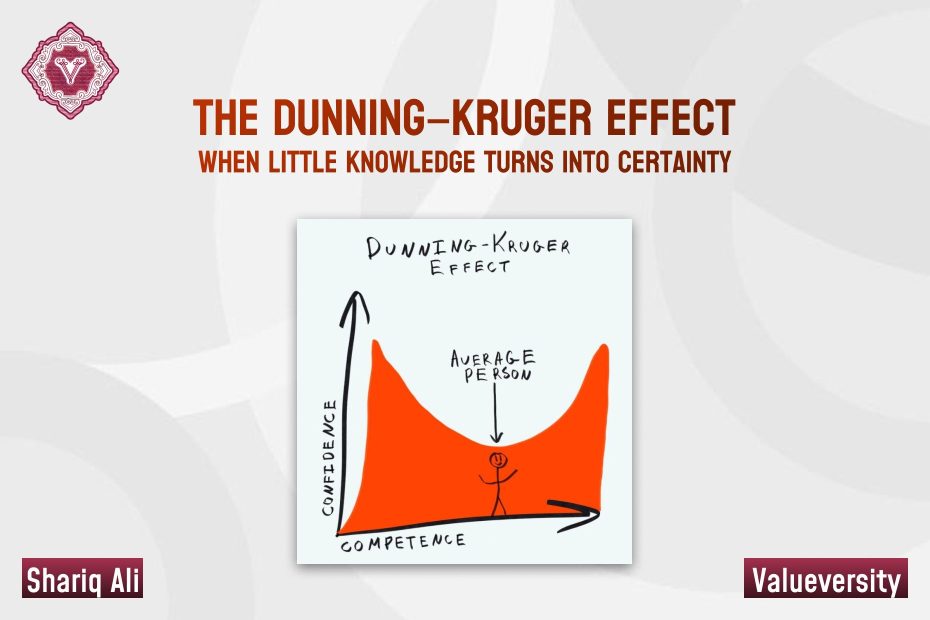
The Dunning–Kruger Effect
When Little Knowledge Turns into Certainty
Shariq Ali
Valueversity
In everyday life, we often encounter people who express firm and definitive opinions on almost every subject with extraordinary confidence. What is surprising is that this confidence is frequently unsupported by deep study, real experience, or solid reasoning. Instead, it is usually built on superficial knowledge and shallow thinking. In the language of psychology, this behavior is known as the Dunning–Kruger Effect.
This term is named after two psychologists, David Dunning and Justin Kruger. According to this theory, individuals with limited knowledge are often unaware of their own ignorance and therefore assume they understand far more than they actually do. In contrast, those who possess genuine knowledge tend to be cautious, curious, and inclined to ask questions continuously.
For example, a person may watch a few YouTube videos and begin issuing confident judgments on complex subjects such as health, economics, or education. Similarly, someone may read half an article on social media and present it as a complete and final viewpoint. On the other hand, a person with deep study and careful observation presents ideas thoughtfully, chooses words with care, and leaves room for revision and disagreement. These are two contrasting examples of the difference between confidence and true understanding.
This tendency becomes particularly visible in religious and political discussions. Some individuals claim, with absolute certainty, that they fully understand every aspect of religious doctrine or political realities, despite lacking logical reasoning, contextual awareness, or familiarity with diverse perspectives. Such people often label questioning as disrespect and disagreement as deviation.
In contrast, a serious-minded individual—especially a scholar or student—presents ideas with evidence, references, and understanding, while acknowledging that knowledge is not a closed door but a continuous journey.
The Dunning–Kruger Effect teaches us that a loud voice is not necessarily a sign of truth. True wisdom lies in humility—in the awareness that there is still much to learn. Perhaps this very attitude can help us become better individuals, better conversationalists, and ultimately, a better society.