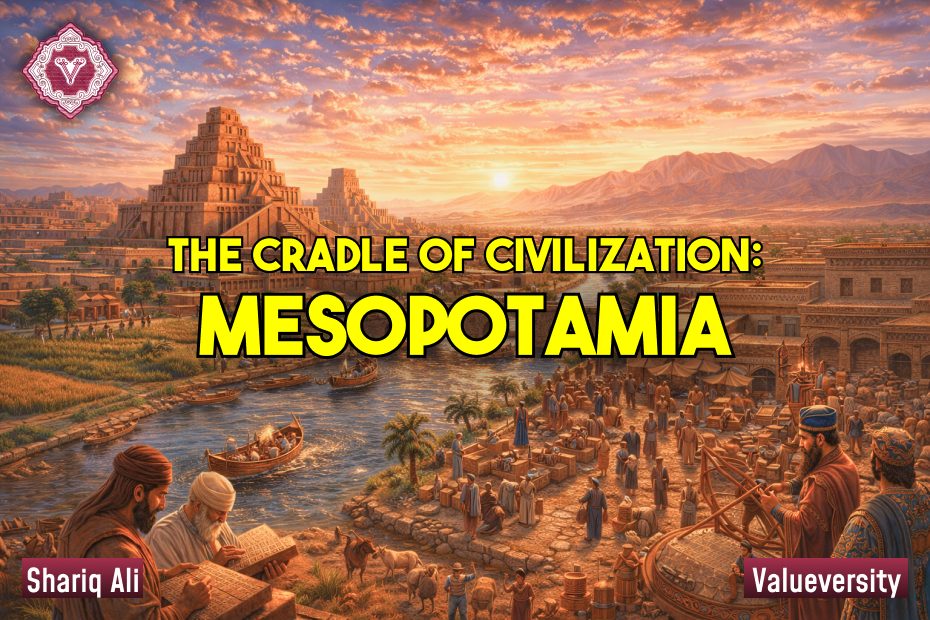
The Cradle of Civilization: Mesopotamia
Shariq Ali
Valueversity
In the fertile plains stretching between the Tigris and Euphrates rivers, more than five thousand years ago, one of the greatest and most decisive civilizations in human history was born.
Mesopotamia. The very name means “the land between the rivers.” It was here that human beings moved beyond simple agricultural settlements and laid the foundations of organized cities and states. In fact, this was the first great leap in the history of human civilization.
The early inhabitants of Mesopotamia learned how to control the waters of the rivers. Canals and irrigation systems were established, leading to abundant harvests and population growth. This process gave rise to cities such as Ur, Uruk, Lagash, and Babylon—centers that were not only hubs of power, but also sources of knowledge, culture, and civilization.
This civilization gifted humanity with innovations that are still part of our everyday lives. Cuneiform script was the world’s first writing system, engraved on clay tablets.
The Code of Hammurabi is counted among the earliest written laws in human history, clearly presenting the principles of justice.
Mesopotamia also played a foundational role in the sciences of astronomy and mathematics.
The division of the circle into 360 degrees, and the system of minutes and seconds, are legacies of that era.
Ziggurats—grand stepped temples—were regarded as symbols of religious and political power.
In Mesopotamia, religion and authority were deeply intertwined.
A complete pantheon of gods existed, and kings considered themselves representatives of these gods on Earth.
Over time, the Sumerian, Akkadian, Babylonian, and Assyrian peoples rose and fell, yet all of them left deep imprints on history.
Even today, when we measure time, create social laws, or perform calculations, we are, in essence, keeping the legacy of Mesopotamia alive.
Mesopotamia was not merely an ancient civilization—it was the first great academy of human history.