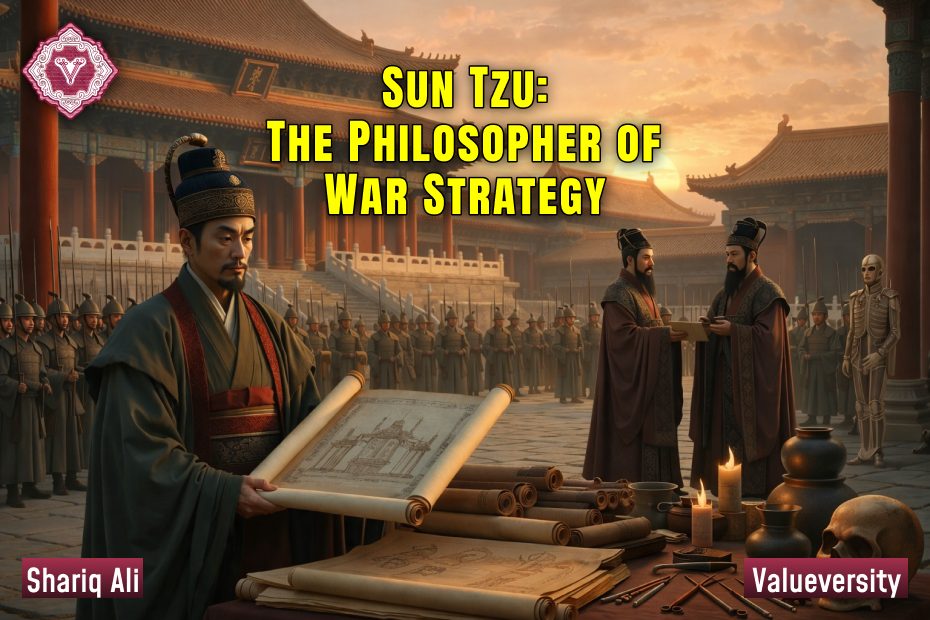
Sun Tzu: The Philosopher of War Strategy
Shariq Ali
Valueversity
In the courtyard of an ancient Chinese royal palace, an unusual scene unfolded. The king of the state of Wu had summoned a young military strategist named Sun Tzu to test his abilities.
To challenge him, the king handed over nearly 180 palace women and said, “If you are truly a great general, turn them into an army.”
Sun Tzu divided the women into two groups and appointed the king’s two favorite concubines as their commanders. Then he gave a command: “Turn right!”
The women burst into laughter.
Calmly, Sun Tzu said, “If orders are not clear, the fault lies with the general.”
He explained the instructions again. But when the women laughed the second time, Sun Tzu announced, “If orders are clear and still not followed, the fault lies with the officers.”
He then ordered the punishment of the two commanders.
After that, the remaining women immediately began following the commands with perfect discipline.
This episode illustrates Sun Tzu’s central principle: the foundation of warfare is discipline and clear leadership.
Sun Tzu is believed to have lived in China in the 6th century BCE and is regarded as a military philosopher and general.
His most famous work, The Art of War, consists of thirteen short chapters in which he presents war not merely as a matter of strength, but as a game of strategy, psychology, and planning.
One of his most famous principles states:
“The greatest victory is that which requires no battle.”
According to Sun Tzu, the finest general is the one who defeats the enemy’s strategy before the battle even begins.
Interestingly, very little reliable historical information exists about Sun Tzu’s life. Yet more than two thousand years later, his book continues to be widely read around the world. Today, its principles influence not only military strategy but also business, politics, and leadership.
Sun Tzu’s enduring lesson is clear: true power lies not only in weapons, but in wisdom and strategic thinking.