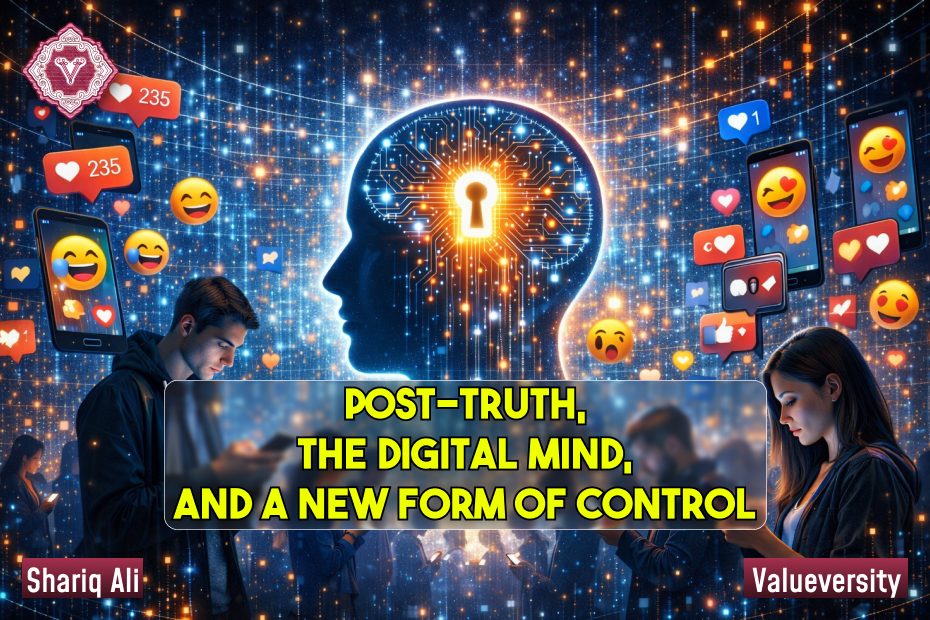
Post-Truth, the Digital Mind, and a New Form of Control
Shariq Ali
Valueversity
We have entered an era in which truth still exists, yet the path leading to it has become blurred. Today, in the formation of opinions, emotions, fear, and anger play a more decisive role than evidence and research. This condition is described as post-truth—a climate in which what matters more than “what is true” is “how we feel.”
The digital world has further accelerated this trend. Social media shows us what we like, what shocks us, or what provokes us—content designed to stir our emotions. As a result, we gradually and often unconsciously become trapped in an echo chamber, where alternative perspectives are neither heard nor able to reach us.
It is within this context that the German philosopher Byung-Chul Han raises a crucial point. According to him, in the modern age power no longer operates merely through coercion or prohibition; instead, it works from within the human mind. He calls this phenomenon psychopolitics—a system in which individuals, while believing themselves to be free, remain under constant pressure to improve themselves, to be more efficient, and to stay perpetually busy. In this way, people are not exhausted by an external dictator, but by their own hands.
This problem can become even more dangerous in developing countries, particularly in societies like Pakistan. Here, media literacy is not evenly distributed, trust in state institutions and political parties is fragile, economic conditions are strained, and emotional narratives spread rapidly. In such an environment, misinformation travels at lightning speed, while the slow and reflective process of reaching the truth through critical thinking fades into the background.
The solution to this problem does not lie in a single slogan, but in the cumulative effect of small, positive habits. Pausing before sharing information, questioning the source of a news item, and cultivating the habit of listening to diverse viewpoints can bring us closer to the truth.
Valueversity believes that it is not violence, noise, or fear, but a transformation of thought that marks the first real step toward genuine freedom.