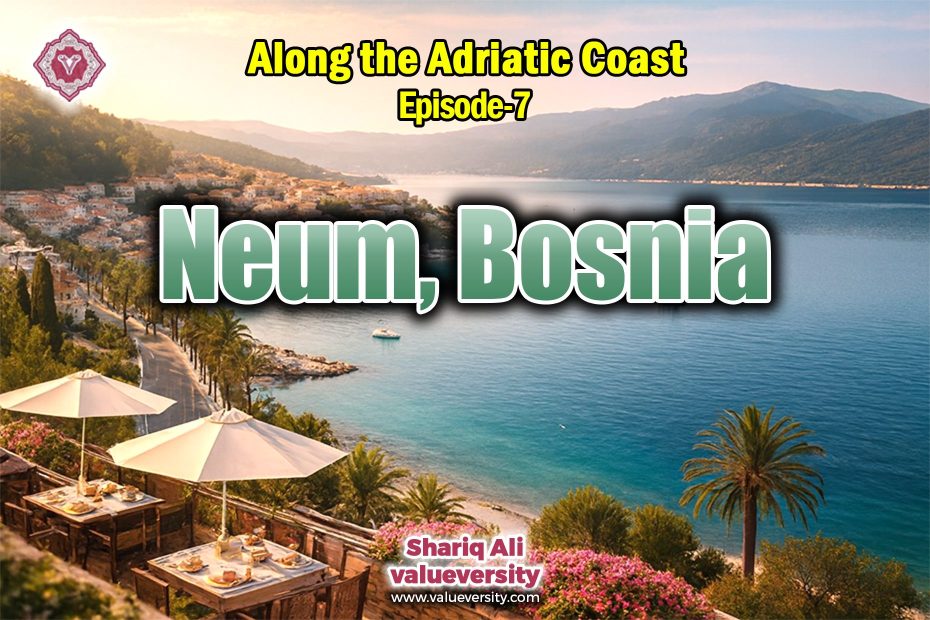
Neum, Bosnia Along the Adriatic Coast
Episode Seven
Shariq Ali
Valueversity
The day began quite early. Today we were heading to the city of Mostar in Bosnia and Herzegovina—a city whose very name conjures images of a river, an ancient bridge arching over it, and centuries-old stories rising together in the mind.
With ten minutes to seven, we left our B&B and reached the coach station located in front of the central post office. This was our designated pickup point, just a gentle downhill walk of five to seven minutes from our accommodation. A few other tourists were already standing there, waiting for the coach.
The coolness of the morning lingered in the air, and the city had not yet fully awakened.
Exactly at seven o’clock, a magnificent black luxury coach pulled up in front of us. Along with it were an experienced driver and a female guide. Her Yugoslav name was rather difficult to pronounce, so everyone began calling her by the simpler part of her name—Sandra.
The driver had a calm and confident demeanor, while the coach itself was brand new and fully equipped: a coffee and snacks vending machine, a washroom, comfortable seating, and a personal entertainment screen for each passenger.
The guide collected all our passports, and then the coach began passing through Dubrovnik’s elegant hotels, picking up more passengers along the way. Before long, we were gliding along the coastal highway, with the Adriatic Sea accompanying us on our journey.
There were forty-eight passengers on board, along with two members of staff—making a total of fifty people. Soon, our convoy reached the border checkpoint between Croatia and Bosnia and Herzegovina.
The coach stopped at a designated point, and we were instructed to remain seated. The guide and the driver took our passports and entered the spacious hall of the nearby immigration office.
For about twenty to twenty-five minutes, we passengers chatted among ourselves. Some watched videos, while others quietly lost themselves in the passing scenery outside.
After a while, the guide and driver returned with the news that the immigration process had been completed smoothly. Passports had been stamped, visas checked, and we had not even needed to step out of the coach.
No questioning.
No long queues.
No direct encounter with any official.
Just like that, we quietly entered Bosnia and Herzegovina.
This entire region was once known as Yugoslavia—a federal state formed after the Second World War, comprising various South Slavic nations. Over time, ethnic differences, political tensions, and economic challenges weakened the union. Eventually, in the 1990s, Yugoslavia disintegrated, giving rise to several independent states, including Croatia and Bosnia and Herzegovina.
Today, these borders may seem routine, but behind them lies a complex, painful, and blood-soaked history.
Crossing the border, there was no dramatic change in the scenery.
The same road.
The same mountains.
The same air.
The same sea.
Everything felt familiar—yet in terms of history and geography, we had entered a different country with a different background.
After traveling roughly twenty to twenty-five kilometers, our coach entered a coastal town called Neum.
Neum is Bosnia and Herzegovina’s only gateway to the Adriatic Sea. Here, our coach stopped for a breakfast break and parked in front of a beautiful restaurant situated slightly above sea level, overlooking the coastline.
Tourists took their seats at different tables and began placing their breakfast orders.
The quiet wait for breakfast evoked memories of Neum’s history.
This seemingly small and tranquil coastal town holds within its layers a deep story of power, politics, and survival. It is the only coastal city of Bosnia and Herzegovina—a fact that makes it geographically and historically unique.
In the seventeenth century, as the Ottoman Empire expanded its influence in the Balkans, Dubrovnik—then known as the Republic of Ragusa—was a prosperous but militarily weak trading state. Maritime trade was the backbone of its economy, and its greatest concern was safeguarding itself from major invasions.
Driven by this fear, and guided by remarkable political foresight, Ragusa made an unusual diplomatic decision. It handed over this narrow strip of coastline—lying between its northern and southern territories—to the Ottomans, granting them access to the sea. In return, Dubrovnik secured a protective buffer zone that shielded it from direct attack.
That very decision is what today connects Bosnia to the sea and divides Croatia into two land segments.
Neum is not merely a city—it is a living example of diplomacy,
where wars were won not by swords,
but by lines drawn on maps.
Today, Neum is a simple, relatively quiet coastal town. It lacks the bustle seen in Dubrovnik or Split, yet in its calm atmosphere, the whispers of history can still be clearly heard.
Breakfast came to an end. The coach was ready to depart once again.
Now we were heading inland into Bosnia—toward a city hidden among mountains, valleys, and stories, where a single bridge has not only connected two riverbanks, but has also united history, culture, and human hearts.
Mostar was waiting for us…
To be continued.