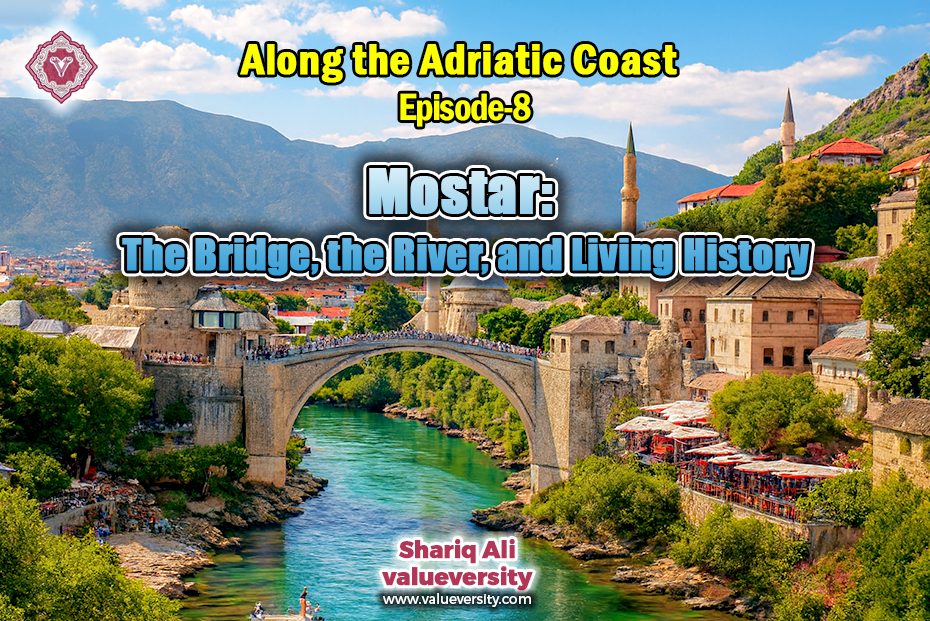
Mostar: The Bridge, the River, and Living History — Along the Adriatic coast
Episode Eight
Shariq Ali
Valueversity
Our coach was heading from Neum toward Mostar. I sat by the window, quietly observing the passing scenery with a subdued curiosity. Along the way there were neither lofty mountain ranges nor lush green plains. Instead, gently rising hills covered with shrubs, mostly dry and barren land, and here and there faint signs of agriculture came into view. Towns and villages appeared sparsely populated, slow-paced, and silent. People could be seen sitting outside roadside shops or on the thresholds of their homes. There was no hurry on their faces, no clear sign of urgency or busyness. It did not look like poverty, yet it felt as though time itself had somehow paused.
This region has a Muslim-majority population. Life appears simple, resources limited, and the pace of living unhurried. Perhaps geography also shapes human temperament and culture. It is possible that barren hills, less fertile land, and limited opportunities have bestowed this stillness upon life here.
After about an hour and a half, our coach entered the limits of Mostar.
The scene outside the window began to change, as if the city were slowly introducing itself. At first, relatively modern areas appeared—apartment blocks, small shops, children standing outside schools, and everyday life unfolding along the roadside. It looked like any ordinary small European city. Yet in the background, gently rising hills stood as a distinctive signature of this place.
Soon we reached the coach station. As we stepped out into the parking area, a new guide was waiting for us, holding an umbrella. Everyone was gathered in one place. We were given a short break of five to ten minutes, followed by a brief introduction and a few necessary instructions. Then we were asked to follow her. I sensed that alongside the guide, the city itself would speak to us—through its streets, its passersby, and its stories.
Mostar is a city in Bosnia and Herzegovina whose identity is bound to a bridge, a river, and a collective memory stretching across centuries. Its name, Mostar, means “the city of bridge keepers.” It has always been a symbol of connection—between East and West, between past and present, and between wounds and hopes. Its famous bridge over the River Neretva, the Stari Most, was built in the sixteenth century during the Ottoman era. It is not merely a structure of stone, but living history.
The destruction of this bridge during the war of the 1990s was not just the loss of a building; it was a deep wound inflicted on collective memory. Its reconstruction using traditional methods and original stones became a symbol of the idea that nations, if they choose, can reconnect themselves after being torn apart.
Following the guide, we first passed through the modern part of the city.
About ten minutes later, we reached the historic bridge area, surrounded by countless small and large shops catering to tourists. Then appeared the iconic arched stone bridge itself, gracefully curved, with the turquoise waters of the Neretva flowing beneath it. Crossing the bridge, we entered old Mostar—narrow stone-paved streets, rows of shops, copper utensils, handicrafts, and the aroma of Turkish coffee. We reached a mosque, where a few quiet moments were spent in silent prayer.
On our way back, we saw a row of restaurants built along the hillside by the riverbank, almost all packed with tourists.
Fortunately, we found a place in a well-appointed restaurant where the river, the bridge, and the young men standing atop it—preparing to dive—were clearly visible. In summer, local youths leaping from this height into the icy cold water is not merely a tourist spectacle, but a continuation of bravery, identity, and tradition. We enjoyed exceptionally delicious, high-quality halal food there—simple, yet memorable.
Although signs of war are still visible on the city’s walls, life has gradually reorganized itself. Today, Mostar is a city where history feels alive and breathing—a city that has endured pain, yet has never let go of hope.۔۔۔۔۔۔ To be continued…