🌿 Kravice Waterfalls, Along the Adriatic coast,
Episode Ten
Shariq Ali
Valueversity
Our coach was travelling from the Bosnian city of Mostar toward Kravice National Park. The scenery kept changing along the way.
Bosnia and Herzegovina is a relatively small yet exceptionally beautiful country. It covers an area of approximately fifty-one thousand square kilometres and has a population of around 3.3 million. Despite its small size, three major languages are spoken here: Bosnian, Serbian, and Croatian. Social life values simplicity, hospitality, and the central role of family. The economy is largely based on agriculture, tourism, and small industries, while its distinctive geography—comprising mountains, rivers, and lush green valleys—endows the country with remarkable natural beauty.
Looking out through the coach window, one did not see the glittering prosperity or dense greenery typical of Western Europe. Instead, clusters of thick trees and gently rising hills covered with shrubs appeared frequently along the route.
We passed through several small towns. Modestly comfortable homes, old-model cars parked in front, and lives wrapped in simplicity—yet within that simplicity there was a quiet dignity and composure. Small houses with red roofs, old-style shops, and people sitting outside their homes chatting. It felt as though life here still moved at a slower pace. The local economy largely depends on agriculture, woodcraft, and small-scale trade. Despite limited resources, people believe in contentment and mutual cooperation. Memories of past wars still linger on some buildings and faces, yet life continues forward with resilience and hope.
As the coach entered the boundaries of Kravice National Park, the scenery changed completely. Greenery, freshness, and the vitality of nature spread in every direction. The coach stopped near the main entrance. Our guide collected ten euros per person and went toward the inner ticket gate. A few minutes later, she returned and distributed the tickets. One by one, tourists stepped off the coach in a civilized manner—without haste, waiting their turn, and respecting others.
There were two options from here: either walk along a two-furlong footpath to reach the main waterfalls, or purchase a one-euro ticket to ride a monorail-style vehicle that ran along a track and reached the main spot in just two minutes. We chose the ride, while the children preferred to walk. Along the way, a wooden pedestrian pathway and a fast-flowing small stream ran beside us.
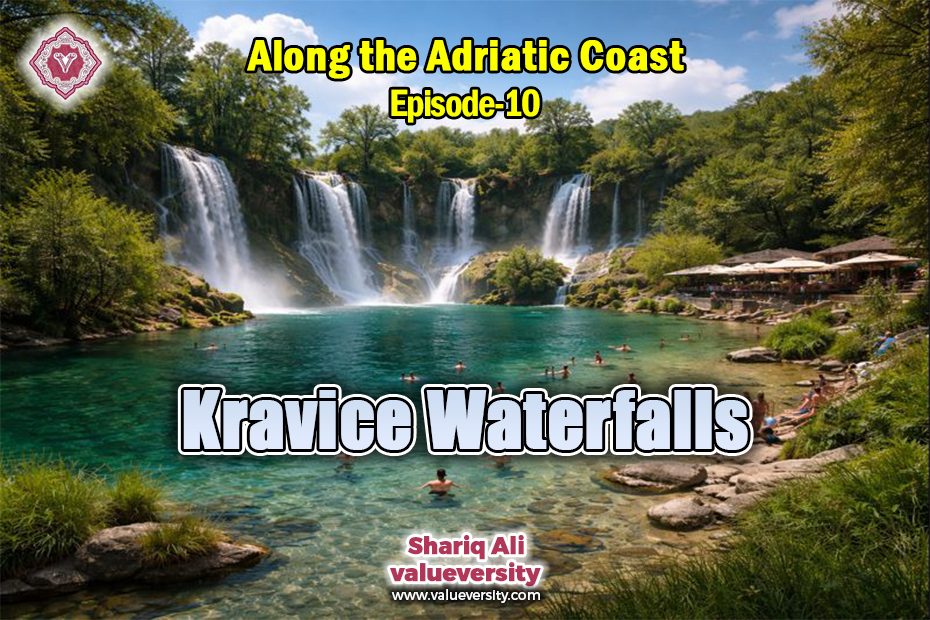
Eventually, we reached the central area of Kravice National Park. This was the edge of two small yet enchanting lakes. Looking ahead, five or six waterfalls could be seen cascading from different faces of rocky cliffs, falling from a height of about thirty to forty metres into these lakes.
It felt as though nature had draped white silken curtains between green-covered hills, letting them descend gently to the surface of the lakes. The roaring water calmed instantly as it merged into the crystal-clear, turquoise lake below. The water was so transparent that one could clearly see the round stones resting at the bottom near the shore. The lake’s depth was perhaps no more than four or five feet, which is why many people—especially children—were swimming. Our children joined them as well.
A cool mist repeatedly brushed the faces of people sitting or standing by the shore, while the constant sound of cascading water echoed like a soothing melody throughout the surroundings.
Along the lakeside stood a row of small and large restaurants built from local wood and bricks. Many tourists, including us, were enjoying food and drinks there. The children preferred swimming in the lake, while Mona and I quietly enjoyed tea, the stillness, and the beauty of the view. It felt as if nature’s splendour and human amenities had formed a peaceful and friendly agreement here.
These waterfalls, the lake, the flowing water—merging, advancing, slipping over rocks, spreading smoothly to become a mirror—were not feats of human engineering. This was nature itself, preserved here in its original form.
At that time, around 150 to 200 people were present in the park. Most were European men and women, many in swimming attire—yet remarkably, despite the crowd, there was no rudeness, no disorder, no noise, no pushing, and not a single harsh or inappropriate remark could be heard. Everyone respected one another’s privacy and behaved with courtesy. Despite Western clothing and lifestyle, manners were refined and personal boundaries dignified.
I was reminded of families picnicking along Karachi’s beaches and their sense of helplessness. Morality is often linked to religion, whereas in reality it is deeply connected to education, upbringing, and culture—and to the respect one human being holds for another.
Here, men and women in swimming attire were presenting a different truth, without making any loud moral claims: consideration, respect for privacy, discipline, adherence to law, and regard for human values.
If only we could provide the same sense of safety and respect to families visiting public places in our own country.
We spent nearly two hours by these waterfalls. Time seemed to slip away unnoticed. At the scheduled hour, we walked back to the main gate and resumed our journey by coach.
If nature has bestowed Bosnia and Herzegovina with a special blessing, it is its rivers. We were now travelling back toward Dubrovnik, but the journey would take us through beautiful valleys settled along the banks of these rivers… to be continued.