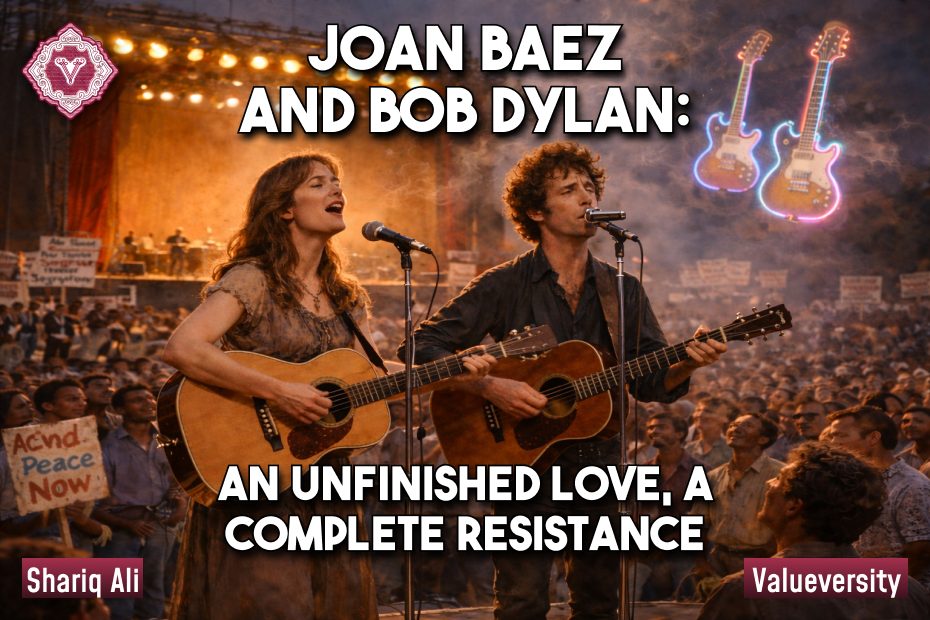
Joan Baez and Bob Dylan: An Unfinished Love, A Complete Resistance
Shariq Ali
Valueversity
The America of the 1960s was a land of dreams and defiance—marches for racial equality, protests against the Vietnam War, and restless young voices demanding change. Questions echoed everywhere.
Amid those questions, two voices rose above the noise: Joan Baez and Bob Dylan. They were not merely singers; they were the conscience of their time.
Joan Baez had already become a powerful voice in the civil rights movement. When she first heard a young songwriter named Bob Dylan, she recognized in his words a spark of rebellion and truth. She invited him onto her stage, and thus began an artistic partnership that gradually turned into a quiet, unspoken romance.
Dylan’s lyrics were not just songs—they were questions:
“How many roads must a man walk down
Before you call him a man?”
And then the line that became the anthem of a generation:
“The answer, my friend, is blowin’ in the wind.”
In Joan Baez’s clear and luminous voice, these lines transformed into both protest and hope. When they stood together at the Newport Folk Festival in 1963, it felt as though music and love were breathing in the same rhythm.
With time, their paths diverged.
Dylan moved toward electric music, breaking tradition and facing criticism. Baez remained steadfast in her commitment to human rights and activism. Yet even their separation carried dignity and mutual respect.
Today, when their songs are heard, it is not merely melody that resonates. We hear an unfinished love, a shared dream, and the heartbeat of an entire era.
Their story reminds us that sometimes two voices, when joined together, can alter the course of history. And love—even when brief—can leave behind a lasting echo.