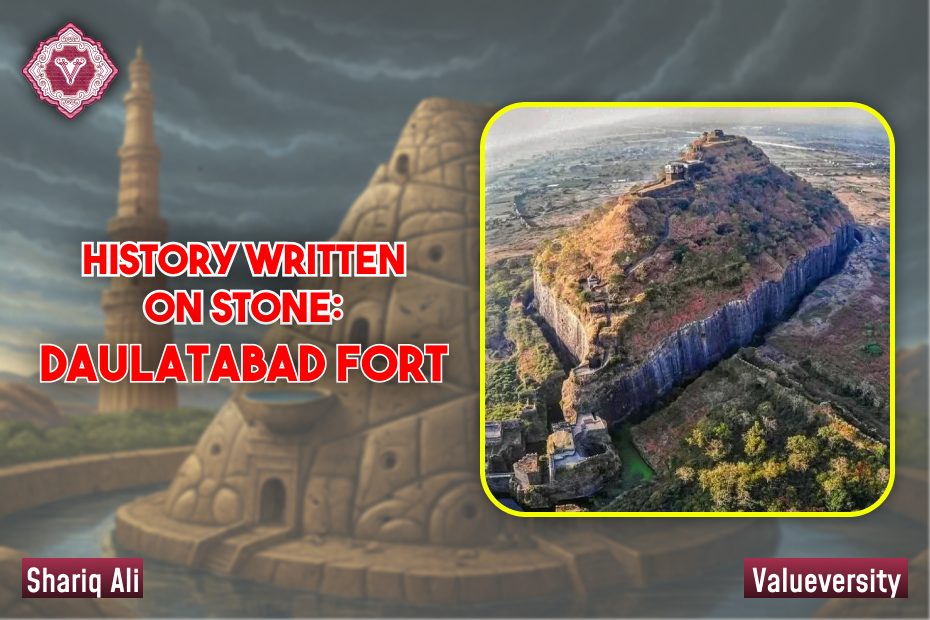
History Written on Stone: Daulatabad Fort
Shariq Ali
Valueversity
Just imagine…
a solitary, conical rock rising nearly fifty meters above the ground.
Silent plains spread at its base, and above them a structure that feels as if history itself has taken the shape of stone.
This is not a legend or a mythological tale.
This is the story of Daulatabad Fort.
A fort born from the fusion of time, power, and human intellect.
A journey from the Hill of the Gods to the City of Wealth.
In the twelfth century, the Yadava dynasty laid the foundation of this fort.
At that time, it was called Devagiri, meaning the Hill of the Gods.
The very name declared that this was no ordinary place, but a special one.
This fort was not built on flat land; it was carved directly out of solid rock.
Steep vertical walls on all sides, a deep moat below,
and narrow, twisting, labyrinthine paths leading upward—
paths designed to exhaust the enemy not only physically, but mentally as well.
Daulatabad was a fort protected not merely by walls;
its true strength lay in its defensive philosophy.
Here, battles were not fought only with swords—
here, the enemy’s senses were attacked.
Dark tunnels where light suddenly vanished.
Sharp turns where horses and elephants became helpless.
Bats living in the tunnels that would suddenly swarm the invaders.
Openings above from which boiling oil or stones could be poured down.
This fort was like a living trap,
slowly tightening its grip around the enemy.
Water, Wisdom, and Self-Sufficiency
One astonishing fact is that water scarcity never became a decisive problem here.
Reservoirs carved inside the rock stored rainwater.
Sieges could last for months,
yet the fort remained self-sufficient.
It reminds us that great civilizations do not only win wars;
they also know how to organize life.
When Delhi Turned Toward the Deccan
In the fourteenth century, Sultan Muhammad bin Tughlaq made a bold decision:
to shift his capital from Delhi to Daulatabad.
The experiment proved historically unsuccessful,
but it placed Daulatabad at the very center of the subcontinent’s history.
Later, the fort passed through the hands of the Bahmanis, Ahmadnagar rulers, the Mughals, the Marathas, and the Nizams of Hyderabad—
yet its awe and reputation for invincibility always endured.
Chand Minar
A Symbol of Victory
Within the fort stands the Chand Minar,
a silent yet towering testimony to triumph.
This minaret is not just brick and stone;
it is a symbol of the artistic sensibility, political power,
and cultural expression of its era.
A Lesson Still Alive
Today, when a young person or an ordinary reader walks along the paths of Daulatabad,
they do not see just a fort—
they witness a journey of human thought, planning, and courage.
Daulatabad teaches us that true power lies not merely in height,
but in vision.
The fort still stands today—
silent, strong, and dignified,
as if history itself has been preserved in stone.