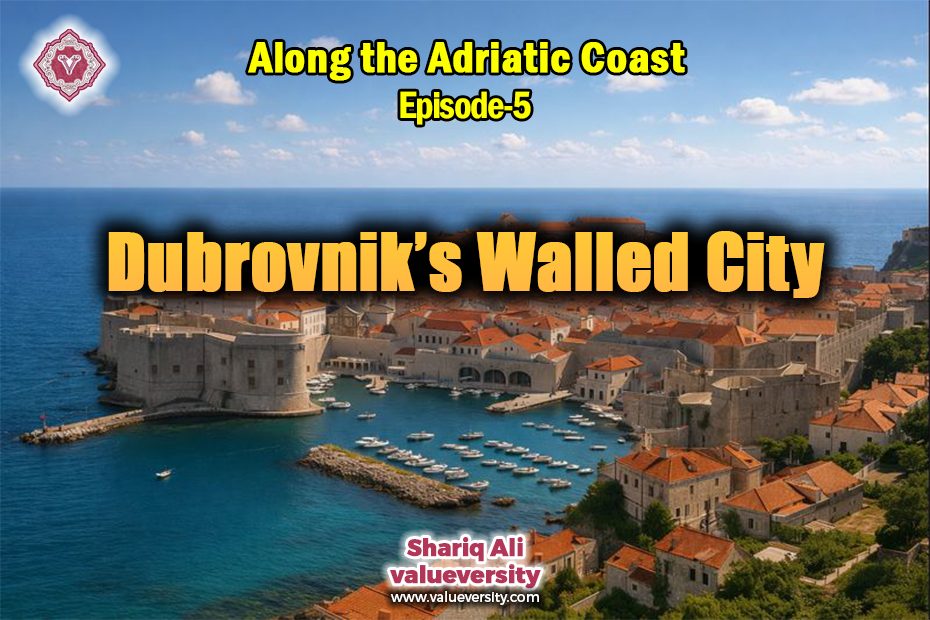
Dubrovnik’s Walled City, Along the Adriatic Coast
Episode Five
Shariq Ali
Valueversity
When we reached the mountain summit by cable car and stepped outside, we were greeted by a vast, semi-circular viewing gallery. Walking through its various sections, one could enjoy breathtaking aerial views of Dubrovnik from every direction.
From the height of the gallery, we then descended a few stone-carved steps and arrived at a charming restaurant below.
By carving the mountain into multiple levels and arranging open-air tables shaded by colorful umbrellas, the restaurant had been given a completely distinct character and atmosphere. The moment we sat down, the open sky, the far-stretching sea, and the scattered islands captivated the eyes. The smart and lively hosts—both young men and women—were dressed in traditional Croatian attire. As lunchtime was still some way off, we ordered coffee and snacks and spent a pleasant while there.
We then boarded the chairlift again to descend, and afterward proceeded on foot toward the main gate of the Walled City.
This ancient fortified city of Dubrovnik, known as the Walled City, was settled in the seventh century. During the Middle Ages, it was called the Republic of Ragusa. The city was renowned for its strong defensive walls, maritime trade, and diplomacy. Remarkably, slavery was abolished here in 1416—a highly unusual decision for that era. Narrow lanes, ancient churches, and marble-paved streets within the walls still keep its history alive today.
As soon as one enters through the main gate, it feels as though one has stepped into an ancient fortress. The tall, rocky stone walls, the central gateway, and the descending stepped passageway beyond it all evoke the image of a strongly defended city.
Here, the hills have been carved and streets constructed on multiple levels to the right and left. As you descend the central staircase, you continue to see rows of houses and restaurants lining the streets spread across different tiers. If you wish, you can wander through these lanes at leisure.
Along both sides of the main descending passageway, small stalls appear here and there, alongside restaurant entrances and various shops catering to tourists. We continued to descend slowly along these carved steps until we finally reached the main street of the city’s core—the inner city.
The earliest inhabitants of Dubrovnik’s Walled City were mostly citizens of an independent maritime republic known as Ragusa. Their culture was a beautiful blend of Roman, Slavic, and Mediterranean civilizations. They wore simple yet elegant clothing—long robes made of wool and cotton, reflecting restraint and dignity in their colors—while the nobility adorned themselves with light jewelry and embroidered garments. Their livelihoods largely depended on maritime trade, shipbuilding, the salt trade, and diplomacy. Interestingly, Dubrovnik chose trade as its weapon, not war, by maintaining a balance between powerful empires. Its people were known for punctuality, a passion for written contracts, and deep respect for the law. This is why such a small city managed to preserve its independence for centuries. The early abolition of slavery—one of the first in Europe—stands as remarkable evidence of the enlightened thinking of its citizens.
Upon reaching the main street, the five of us made a decision. Mona and I stayed together, while the children each set off in different directions to explore the small city on their own. We were all to meet back at the same spot at a fixed time for lunch.
To be continued…