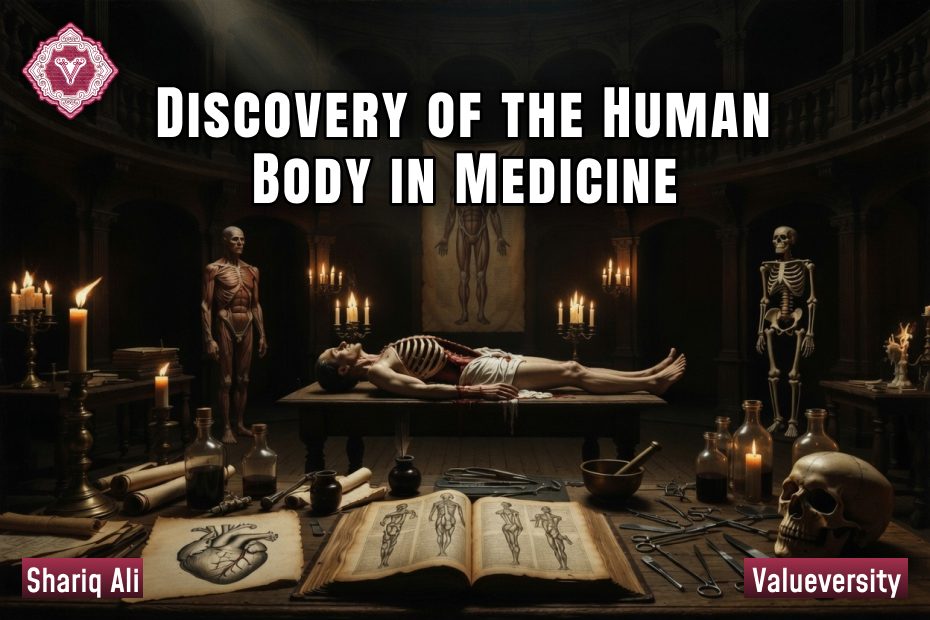
Discovery of the Human Body in Medicine
Shariq Ali
Valueversity
In the anatomical hall of the ancient University of Padua, a crowd of students had gathered. In the center of the room, a human corpse lay on a table. Standing beside it was a young teacher, carefully dissecting and explaining the human body with his own hands.
For that time, it was a remarkable and unusual sight. In those days, teachers usually only read from books and rarely engaged in practical work.
But this young scholar was a rebel against tradition. His name was Andreas Vesalius.
Vesalius was born in Brussels in 1514. He studied in Leuven and Paris and in 1537 received his medical degree from the famous University of Padua in Italy. Soon after, he became a professor of anatomy there.
At that time, medical education relied heavily on the writings of the ancient Greek physician Galen, whose ideas had been accepted as unquestionable truth for centuries.
Vesalius challenged this long-standing tradition.
Through direct dissection of the human body, he began systematic research and taught his students that knowledge does not come from books alone—it must also come from observation and experiment.
In 1543, he published his famous book De Humani Corporis Fabrica (“On the Fabric of the Human Body”). The book described the structure of the human body with hundreds of detailed anatomical illustrations.
For the first time in human history, anatomy was presented in such a clear and scientific manner.
Through his research, Vesalius demonstrated that many of Galen’s descriptions were incorrect, largely because Galen had mostly dissected animals rather than humans.
Vesalius’s courageous work opened a new era in the history of medicine. For this reason, he is rightly regarded today as the founder of modern human anatomy.