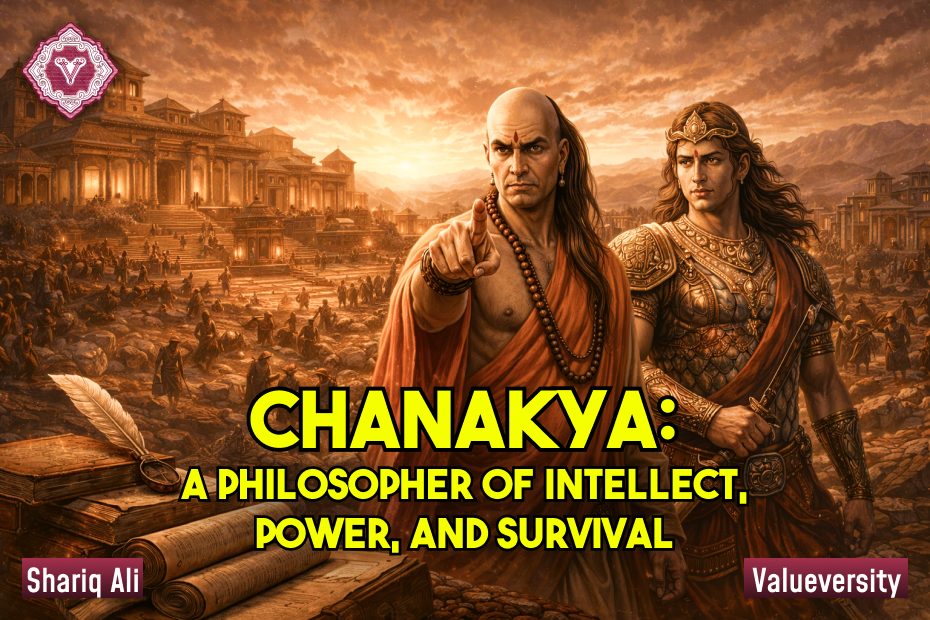
Chanakya: A Philosopher of Intellect, Power, and Survival
Shariq Ali
Valueversity
Chanakya, also known as Kautilya or Vishnugupta, is counted among those extraordinary figures of ancient India who altered the course of history. He was likely born in the fourth century BCE. Historians believe that his birth and upbringing were closely connected with the scholarly environment of Taxila, where he studied philosophy, politics, and the science of statecraft. Taxila was a great university of its time, and Chanakya was a product of that rich intellectual milieu.
Chanakya’s fundamental approach was realist, not idealistic or romantic. He viewed human beings as they truly are,
power-hungry, self-interested, and opportunistic.
This realism finds its finest expression in his renowned work Arthashastra, a comprehensive manual on politics, economics, espionage, defense, and governance.
Chanakya transformed Chandragupta Maurya from an ordinary young man into the founder of the first organized empire of the Indian subcontinent. This alone is the greatest proof of his historical significance.
His famous saying:
“Even if a snake is not venomous, it should appear to be so,”
encapsulates the essence of Chanakya’s entire philosophy. He does not preach violence; rather, he emphasizes self-preservation. In his view, the display of power is often more effective than the actual use of power.
One who is excessively soft is crushed by the world, while one who appears dignified, informed, and strong naturally develops a protective aura around himself.
Chanakya is still alive today,
in every person who knows how to balance power with wisdom.
This is his true legacy.