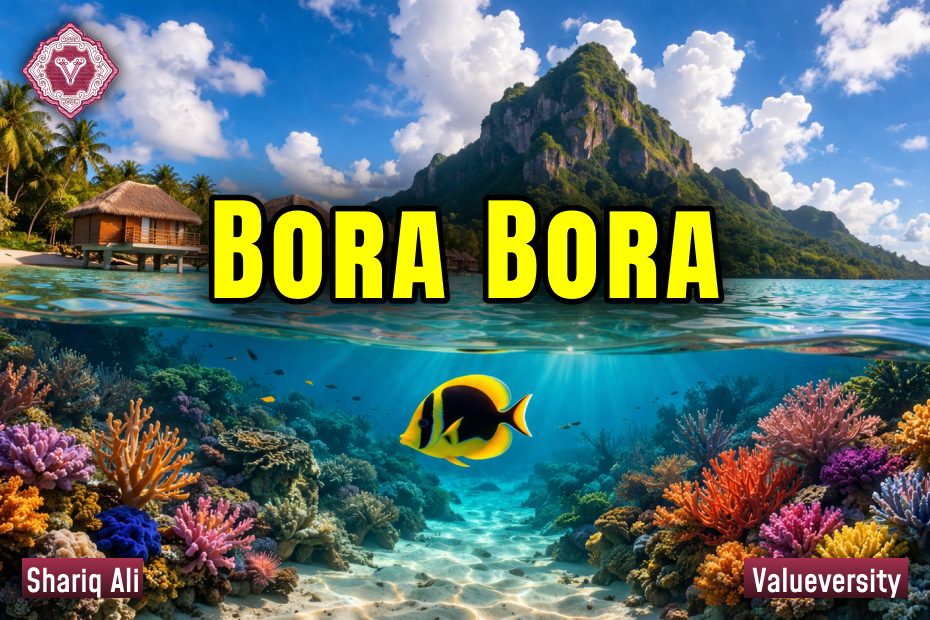
Bora Bora
Shariq Ali
Valueversity
Sometimes, in one’s thoughts, one should drift toward an island where there is no noise, where the bitterness of news about conflict does not exist, where the complications created by humans—such as war, politics, and the relentless race of economics—are left behind.
An island where only the gentle sound of flowing water can be heard, and peace is dissolved into the air.
When I think like this, an image emerges: Bora Bora.
I have never traveled to this island. But I have read about it, seen its pictures, and certainly imagined it. In my mind, I have built a whole world there.
Located in the South Pacific Ocean, this island is part of French Polynesia, which is, in fact, an overseas territory administered by France. In other words, it is not an independent country but falls under French administrative governance.
Bora Bora is not an uninhabited dream; it has a population of around ten thousand people, mostly native Polynesians. In the modern world, the island’s primary identity is tourism. People from across the globe come here to experience its crystal-clear waters, overwater bungalows, and tranquil environment. The surrounding coral reefs not only add to its beauty but also provide a protected ecosystem for marine life.
Interestingly,
Bora Bora is actually the remnant of an ancient volcano, which time has transformed into a scene resembling paradise. Yet alongside this beauty lies a fragile and harsh reality.
Climate change and rising ocean temperatures are becoming a threat to these coral reefs.
This piece is not written by a traveler, but by a dreamer.
Perhaps the opportunity will come, perhaps it won’t—but this island remains a symbol of the search for peace.