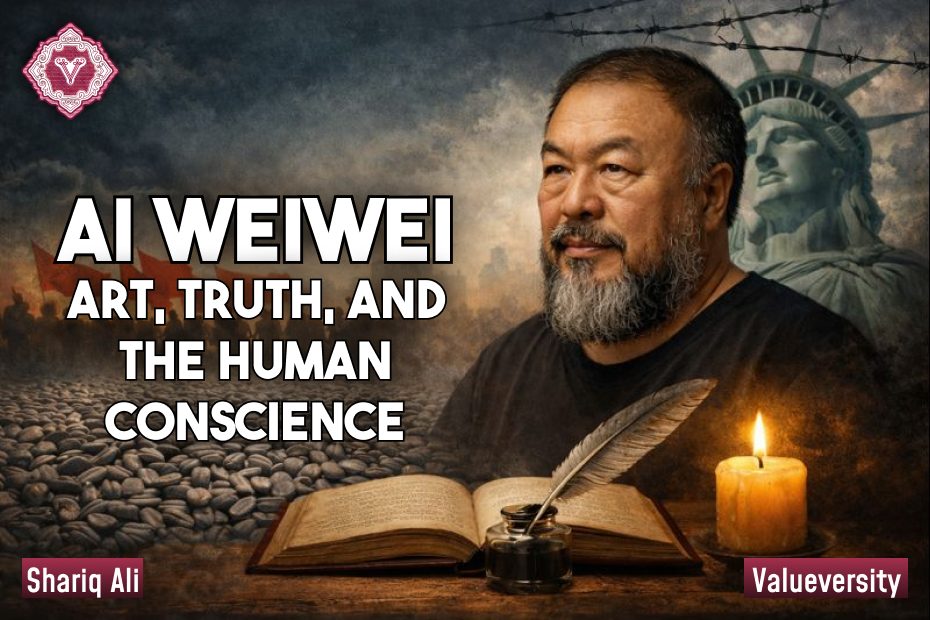
Ai Weiwei Art, Truth, and the Human Conscience
Shariq Ali
Valueversity
Ai Weiwei is among the few outstanding minds of our time for whom art is not merely a source of beauty or entertainment, but a moral responsibility to speak the truth under all circumstances. He is not a poet in the traditional sense, yet his art, writings, and worldview possess a depth of meaning that, like poetry, speaks simultaneously to the heart and the conscience. He stands at once as an artist, a thinker, and a witness to the truth of his age.
Ai Weiwei was born in 1957 in Beijing, the capital of China. His father, Ai Qing, was a renowned Chinese poet who endured state oppression, humiliation, and exile because of his political beliefs. Experiencing exile, deprivation, and insecurity during childhood deeply shaped Ai Weiwei’s understanding that power is not challenged through silence, but through questioning and steadfast commitment to truth. This awareness later became the foundation of his artistic and intellectual journey.
He received his early education in China and later pursued formal training in the arts in the United States. There, exposure to ideas such as freedom of expression, individual autonomy, and human rights further strengthened his intellectual framework. Upon returning to China, he broke away from traditional artistic conventions and began creating works that are not merely meant to be seen, but to provoke thought, discomfort, and critical questioning.
Among his most well-known works, the installation composed of millions of hand-crafted porcelain sunflower seeds is particularly significant. At first glance, the work appears vast and deceptively simple. In reality, each seed represents an individual human life.
Through these countless individual forms compressed into a collective mass, Ai Weiwei raises a powerful question: have we reduced human beings to numbers, crowds, or mere statistical units?
Similarly, his installations documenting the names and details of earthquake victims are not simply memorials, but quiet yet forceful protests against state indifference. By bringing individual names into public view, he asserts that beyond official reports and numerical data, each human life carries an identity, dignity, and value that must not be erased.
The true strength of Ai Weiwei’s work lies in its moral courage. Where states attempt to conceal the truth, he insists on exposing it. Where societies choose silence, he asks uncomfortable questions. Because of this fearlessness, he has faced imprisonment, constant surveillance, the destruction of his studio, and exile. Yet he has never compromised his position. For him, freedom of expression is not a political slogan, but a fundamental requirement of any humane and just society.
Ai Weiwei’s voice extends far beyond China. He speaks for people everywhere whose voices are suppressed. Whether addressing refugee camps, modern surveillance systems, or the erosion of human dignity in the name of power, he transforms these realities into the subject of his art and writing. In doing so, he reminds us that loyalty to conscience transcends borders, national identities, and ideological divisions.
For the general reader, Ai Weiwei’s significance lies in the belief that even a single individual can become an agent of change, provided they stand firmly with the truth. His art does not merely impress; it compels reflection, questioning, and an awareness of one’s own moral responsibility.
In the context of Valueversity, Ai Weiwei’s life and work convey a clear message: education is not simply the accumulation of information, but the recognition and embodiment of values. Truth, justice, and the sanctity of human dignity are the core principles he represents through his art and thought. He reminds us that when art stops speaking the truth, it becomes mere decoration, and when human beings remain silent, injustice slowly becomes normal.
This article is presented with the hope that the reader becomes familiar with Ai Weiwei’s work, understands its deeper meaning, and asks an essential question within themselves: what role am I playing, in my own time, in standing for truth and humanity?