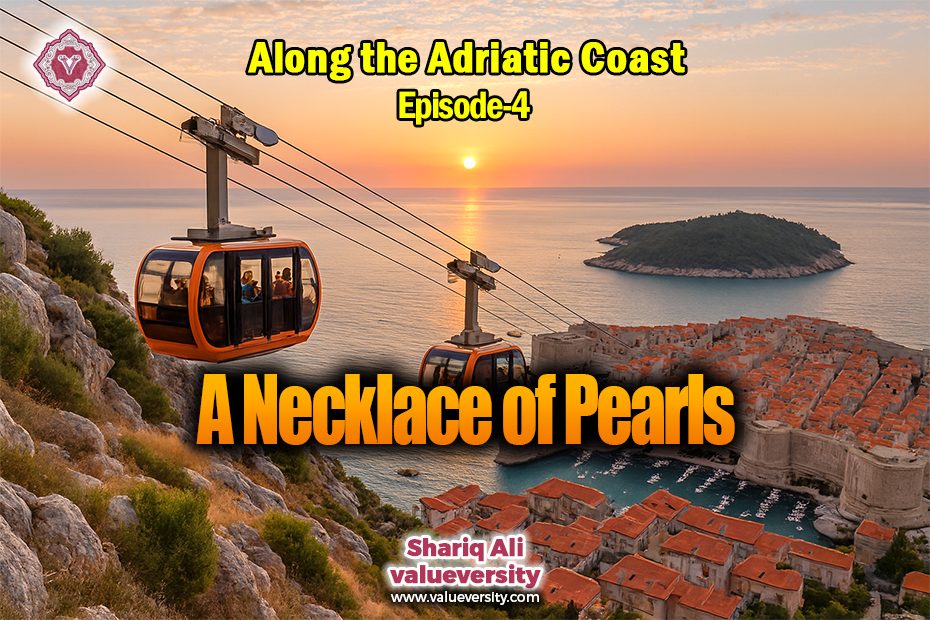
🌅 A Necklace of Pearls
Along the Adriatic coast ,
Episode 4
By Shariq Ali
Valueversity
The soft morning light filtering through the curtains and our habit of waking up early gently stirred us from sleep. The air carried a cool freshness and the salty fragrance of the sea breeze. I moved the curtain slightly aside — and there it was, a blue sky adorned with clouds that looked as if painted by a master artist’s brush. Mona and I exchanged a glance and instantly agreed to have breakfast at home.
The self-catering guesthouse kitchen was small but well-equipped. A stove, utensils, and the ingredients and spices we’d brought along — everything was just to our taste. Mona whisked the eggs while I put the kettle on, and soon the aroma of omelets, croissants, buttered toast, and steaming tea filled the dining room. The familiar scent of homemade tea brought back memories of breakfasts in Karachi.
The children woke up a little later. When they saw the omelets and tea on the table, their faces carried a mix of a smile and mild boredom — that familiar “Oh Dad, not again!” look. We smiled, handed them the Monzo card, and they cheerfully headed toward the promenade. There, at a Tim Hortons or Costa-like café by the sea, they treated themselves to cheese toasties and cappuccinos before returning, laughing and cheerful.
Once both the Eastern and Western breakfasts were done, we ordered an Uber. Within minutes, the car was at our door. Dressed lightly for the weather, we set off for the Dubrovnik Walled City. Our guesthouse was in the coastal outskirts, about fifteen to twenty minutes away.
The Uber dropped us just before the city gates, near the cable car that climbs the hill overlooking Dubrovnik. The ride takes visitors to the top, offering panoramic views of the old walled city, the modern town, and the sweeping Adriatic coastline.
The cable car station had a modest crowd — organized, not overwhelming. We saw German, French, and East Asian tourists, but none of the exhausting queues typical of London, Paris, or Rome.
At the ticket window, we paid twelve euros per person for a round trip, and with the ticket came a warm smile: “Welcome to Dubrovnik!”
We stepped into a clean, spacious cable car surrounded by glass — like sitting in a transparent cage ascending toward the sky. As the car began to rise, the walled city below slowly receded, unfolding like a tapestry of time.
At first, the old city’s red-tiled rooftops looked like a beautifully woven carpet. Higher up, we could see the newer part of Dubrovnik — white and cream-colored houses interspersed with red roofs — as if two streams of history were holding hands.
With each meter of height, the scenery transformed. The Adriatic stretched out before us, a vast sheet of turquoise and deep blue — as though someone had dissolved sapphires in the water. To the left appeared a lush, green island — Lokrum Island — rising from the sea like a character from a storybook.
Just a few hundred meters from the Dubrovnik shore, this mysterious island was once home to Benedictine monks. Legend has it that after their curse, no permanent settlement ever survived there. Today, only olive groves, clusters of coastal trees, and a small salty “Dead Sea” lake remain. The island’s name comes from the Latin Acrumen, meaning “sour fruit,” once famous for its rare plants and citrus orchards.
According to legend, in the 12th century, Richard the Lionheart, King of England, took refuge here after surviving a shipwreck. Later, in the 19th century, Emperor Maximilian of Mexico built a garden on the island and released peacocks there — descendants of which still roam freely today. From the height of the cable car, Lokrum looked like a beautiful fusion of nature, history, and myth.
Beyond Lokrum, the Adriatic is dotted with many enchanting islands encircling Dubrovnik like a dream. The largest and most fertile among them is Šipan, known as the “Golden Island.” It is said to have more olive trees per capita than any other island in the world.
These islands are free of traffic noise — only the whispers of sea winds and the softness of sand underfoot. Their beaches are counted among the rare sandy shores of the Adriatic. Just a short boat ride from Dubrovnik lies another island, with deep blue caves, stone houses, and serene silence — together creating a scene of pure magic.
Scattered across the Adriatic, these islands resemble pearls delicately strung by nature’s hand, forming a glowing necklace that embraces Dubrovnik — timeless, tranquil, and full of wonder.