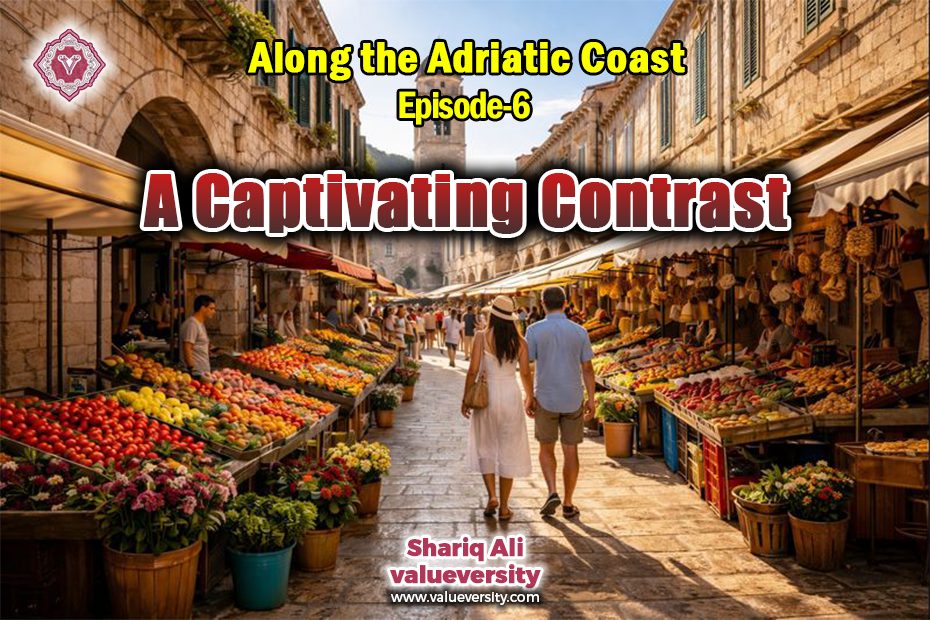
A Captivating Contrast — Along the Adriatic Coast
Episode Six
Shariq Ali
Valueversity
In the central square of Dubrovnik’s old walled city, we agreed to meet again at a fixed spot after an hour and a half, then parted ways to explore the city at our own pace. Mona and I stayed together, while the three children headed off in different directions.
This square is, in fact, a broad coastal expanse situated at the lowest level of the ancient fortified city, only slightly above sea level. Along its edges, stairways carved into the sloping hillsides and built from local stone rise toward higher ground. This entire defensive structure reflects the city’s historic commercial prosperity. Since Dubrovnik was a trading city, the threat of invaders was always present, and these very concerns gave rise to its strong walls and elaborate security system.
Within this central square stand two or three churches that have now been converted into museums and art galleries. Much of their space is used as galleries: paintings hanging on the walls depict historical and religious narratives, while a designated area for worship still remains in the center. Mona lingered with interest over the artwork, while I sat quietly for a while on the benches in the prayer area.
The central square, bustling like a busy marketplace, has in one corner a sloping pathway leading to a large iron gate. This was likely the spot from where boats were once launched into the sea or hauled back in. Although the gate was closed and the outside view hidden, it was easy to imagine that it opened directly onto the seashore.
Dubrovnik—and modern Croatia as a whole—embodies a captivating contrast. The people here are both modern and deeply rooted in tradition. During the day, they appear busy with smartphones, laptops, and electric scooters; yet by evening, the same people stroll slowly along the seafront or through the narrow streets of the old city, as if living life in “slow motion.”
In Croatia, café culture is not merely about drinking coffee; it is a social tradition. People sit for hours over a single cup, talking as if they have conquered time itself. Although the younger generation is fully connected to global fashion, music, and the digital world, pride in their language, folk music, traditional cuisine, and national days remains an essential part of their identity. In cities like Dubrovnik, despite the crowds of tourists, locals do not abandon their daily routines—vegetable markets in the morning, brief work during the day, and evenings spent with family or friends. In this way, the city feels not like a mere tourist exhibit, but a living, breathing society.
At the center of the square and along both sides, markets and shops thrived with full vibrancy, bearing witness to the city’s enduring commercial and social continuity.
After exploring the old city, museums, and harbor views, we regrouped at the agreed time and then set off together for lunch. Based on their TripAdvisor research, the children had discovered a sandwich shop considered the most popular in the area. When we finally found it, we indeed saw a long queue of customers.
Leaving the children standing in line, Mona and I stepped into a nearby viewing gallery, from where the sea stretched out on one side and colorful buses circling the city could be seen on the other. We sat down on a bench in the gallery.
After a while, the children placed their orders—a tuna sandwich for me and a vegetable sandwich for Mona. Once everyone returned with their sandwiches, we decided to head back to our accommodation a little earlier. We would have lunch there, rest for a while, take a gentle evening walk in the nearby area, and go to bed early, as the next day we were to travel to the nearby country of Bosnia, to the city of Mostar.
With this plan in mind, we returned to our lodging relatively early that day. A little rest was necessary before embarking on a new journey.
To be continued…