The Evolution of Intelligence
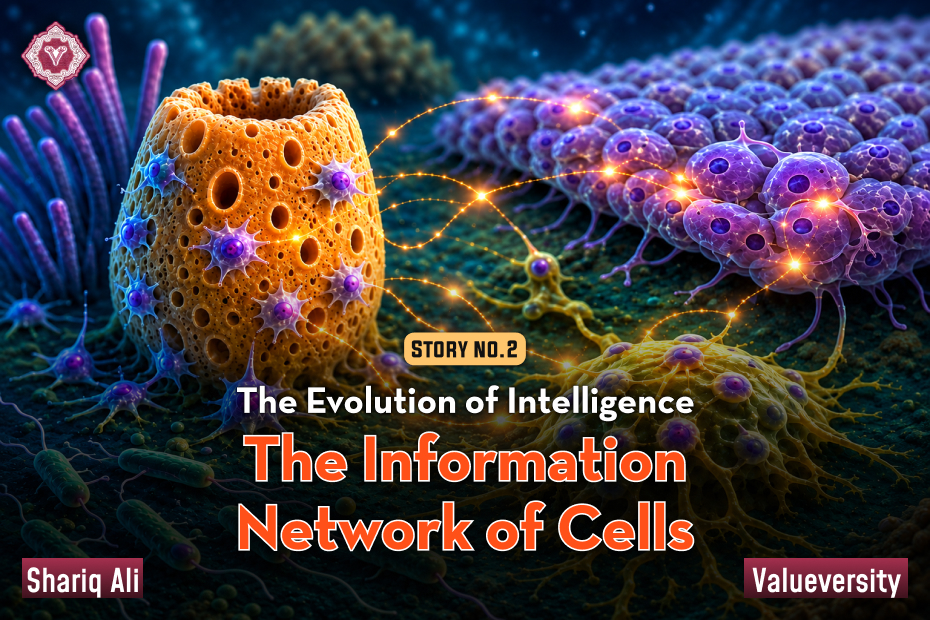
Story No. 2: The Information Network of Cells
Shariq Ali
Valueversity
In the previous story, we saw that the earliest forms of life—bacteria and other single-celled organisms—could sense their surroundings. They moved toward food and away from harmful substances.
Then the journey of intelligence took another remarkable step forward.
A fascinating transformation occurred. Instead of living alone, some cells began to cooperate and live together. This was the stage at which multicellular organisms first appeared.
A simple example can help us understand this change. A single person can accomplish only limited tasks. However, when many people work together as a team, they can achieve far greater and more complex goals. The same thing happened with cells.
In early multicellular organisms, different cells began to take on different responsibilities.
Some specialized in obtaining food, others in providing structural support, and still others in detecting changes in the external environment.
One fascinating example from this era is the sea sponge. Sea sponges still exist today and are considered among the oldest animal groups on Earth.
Remarkably, they possess neither a brain, a heart, nor a nervous system. Yet millions of their cells cooperate in an organized manner. Some cells draw water into the body, others filter food particles, and still others remove waste. In a sense, each cell performs its own task while the entire organism functions like a well-organized society.
What makes this stage particularly interesting is that there was still no brain and no nervous system. Nevertheless, cells were communicating with one another. They sent and received messages through chemical signals. If one part of the body detected a change in the environment, that information was gradually passed on to other cells.
Another intriguing example can be seen in slime molds. Although they are not true animals, they demonstrate a remarkable form of collective behavior. When food becomes scarce, thousands of individual cells come together and move as a single coordinated body. It is almost as if many tiny cells are making one collective decision.
Even today, countless cells within our own bodies are constantly communicating. Hormones and other chemical messengers are excellent examples of this process.
Whenever we run, feel fear, or become hungry, a vast network of information exchange is activated throughout the body.
In this way, evolution gave rise to collective intelligence for the first time. Intelligence was no longer merely a property of a single cell; it had become a shared capability of an entire community of cells.
However, as organisms grew larger and more complex, a new challenge emerged. If danger appeared in one part of the body, how could that information reach the rest of the organism quickly enough?
Chemical signals were useful, but they were relatively slow. Evolution now required a system capable of transmitting information at much greater speed.
This necessity led to the next great evolutionary breakthrough: the emergence of the nervous system.
Join us in the next chapter of this fascinating journey through the evolution of intelligence.