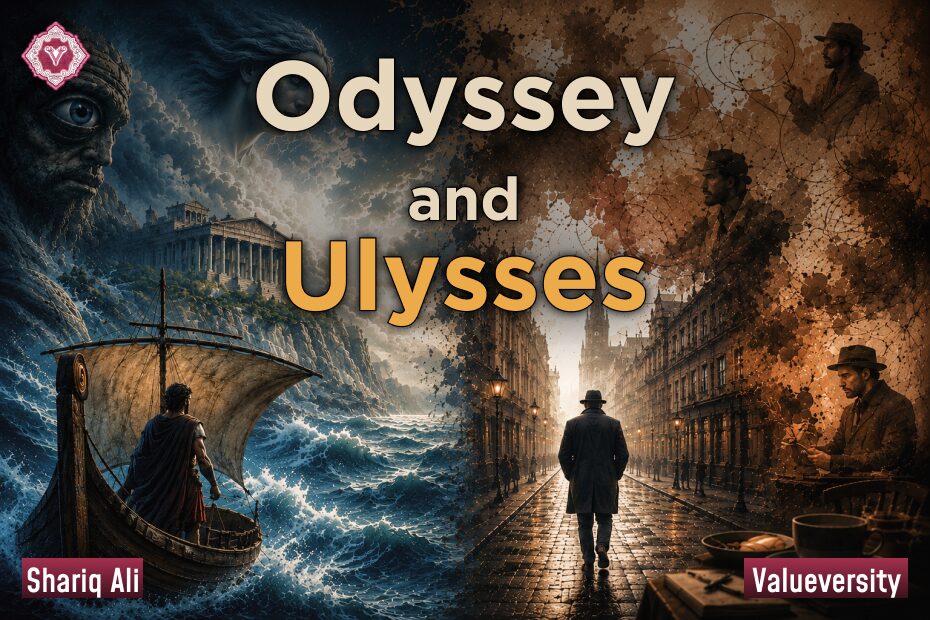
Odyssey and Ulysses
Shariq Ali
Valueversity
One hero wandered through the seas, the other through the streets of a city.
In truth, both were searching for themselves.
This story contains almost everything—
literature, history, human psychology, and the anxieties of both ancient and modern life.
Nearly three thousand years ago, Homer created The Odyssey, likely written in the 8th century BCE.
This epic tells the story of a warrior named Odysseus. The Trojan War had ended, but for him, the real battle had just begun—the battle of returning home.
On his journey, he encountered the one-eyed giant Polyphemus, the sorceress Circe, deadly dangers of the sea, and even the wrath of Poseidon, the god of the sea.
For ten years, he drifted across the oceans trying to return to his island, Ithaca, where his loyal wife Penelope waited for him.
This was not merely an adventure story.
It was a story about the longing to return home, loyalty, patience, trials, and human endurance.
Centuries later, James Joyce transformed this same tale into a remarkable modern form.
He wrote Ulysses, published in 1922. Interestingly, the entire novel unfolds over the course of just one day. The events take place in Dublin on June 16, 1904.
In this story, there are no giants and no violent sea storms. There is only an ordinary man—Leopold Bloom.
He walks through the streets of Dublin, meets people, eats meals, and wrestles with his marriage, memories, desires, and loneliness.
On the surface, nothing extraordinary happens.
But James Joyce’s brilliance lay in showing—through his stream-of-consciousness writing style—that modern human beings experience storms within themselves just as fierce as the storms that once raged in the seas.
So what is the real difference?
Odysseus was fighting external disasters and monsters.
Leopold Bloom was fighting internal emptiness, loneliness, identity crises, and the chaos of modern life.
The ancient hero asked: How do I get home?
The modern human asks: How do I find myself?
Today, many of us do not wander across oceans.
But we wander every day—through the noise of social media,
through recognition anxiety,
through comparison culture,
through loneliness,
and through a constant search for purpose.
Our monsters have changed, but the journey is still not over.
Perhaps that is why The Odyssey and Ulysses remain alive even today.
One story teaches us how to fight the storms of the world.
The other teaches us how to understand the noise within ourselves.
And perhaps humanity’s greatest odyssey is still this:
after conquering the world, learning how to journey back within.