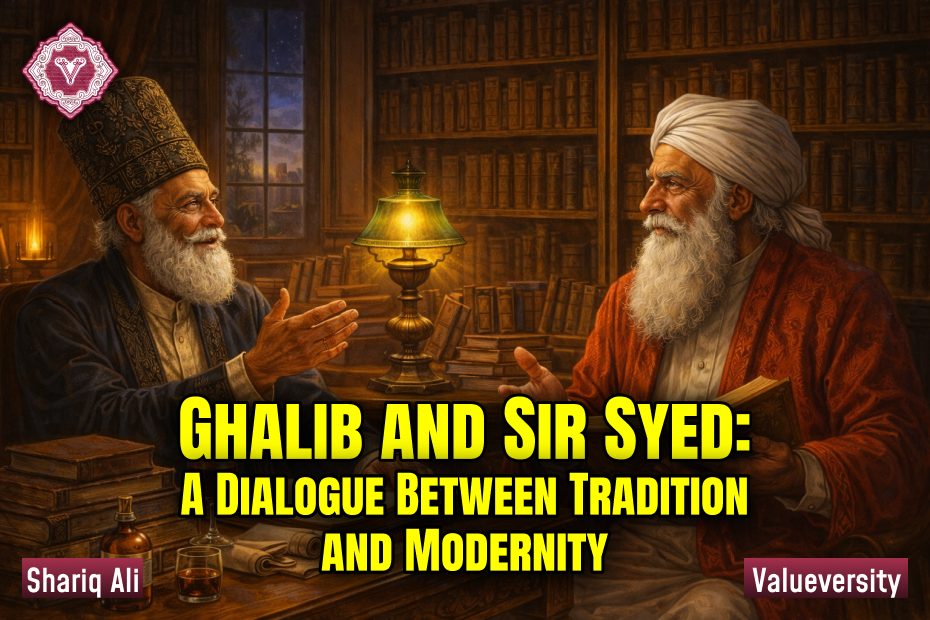
Ghalib and Sir Syed: A Dialogue Between Tradition and Modernity
Shariq Ali
Valueversity
Nineteenth-century India stood at a peculiar crossroads. On one side lay the weight of a glorious past, and on the other, the search for new pathways into the future. The question was: what next?
It is against this backdrop that two extraordinary figures from our history emerge face to face—Mirza Ghalib and Sir Syed Ahmad Khan.
Both were great in their own ways, yet carried an intriguing tension in their ideas. This apparent personality clash, in reality, reflects the intellectual struggle of an entire era.
When Sir Syed Ahmad Khan requested Ghalib to write a foreword for his famous book Asar-us-Sanadid, Ghalib accepted. However, what he wrote was not merely praise—it was an intellectual challenge for the reader.
Instead of looking back at the grandeur of the past, Ghalib urged attention toward the possibilities of the present and future. He argued that true progress lies in learning from the British—particularly in the fields of science and modern knowledge.
This perspective did not sit well with Sir Syed, who at that stage of his intellectual journey was focused on highlighting the cultural achievements of the past. Consequently, he chose not to include Ghalib’s foreword in his book.
This episode became symbolic of the intellectual distance between the two—Ghalib as a free-thinking critic, and Sir Syed as a cautious reformer.
In literary circles, there is also a delightful anecdote—more of a witty tale than a verified historical account—about a bottle of wine in a Delhi inn.
According to the story, when Ghalib was staying at an inn in Delhi, Sir Syed came to know of it and insisted on bringing him to his own home. He arranged a spacious room for Ghalib’s stay.
While settling in, Ghalib placed his bottle of wine prominently in the room, where it was clearly visible. When Ghalib stepped out, Sir Syed quietly removed the bottle and hid it in a back room.
Upon returning, Ghalib inquired,
“Where has my bottle gone?”
Sir Syed replied gently,
“It is safe, Mirza Sahib. Please don’t worry.”
When the bottle was eventually brought back to him, Ghalib held it in his hand, smiled, looked toward Sir Syed, and remarked:
“I suspect some dishonesty in this bottle.”
Sir Syed, given his serious temperament and religious inclination, felt slightly embarrassed and fell silent.
This remark not only reflects Ghalib’s wit but also the warmth in their relationship—where intellectual differences coexisted with mutual regard.
If we look deeper, Ghalib and Sir Syed were, in essence, two responses to the same question—two different paths toward a shared goal.
Ghalib: liberal-minded, critical, and forward-looking.
Sir Syed: a practical reformer, believing in gradual change and collective guidance.
Ghalib raised questions; Sir Syed built systems in search of answers.
Ghalib stirred minds; Sir Syed worked to stabilize society.
Their relationship teaches us that disagreement is not always negative. In fact, differences in perspective often become the driving force behind a nation’s intellectual evolution.
Today, as we search for our cultural and national identity in a modern world, perhaps we once again need Ghalib’s boldness—and Sir Syed’s wisdom.