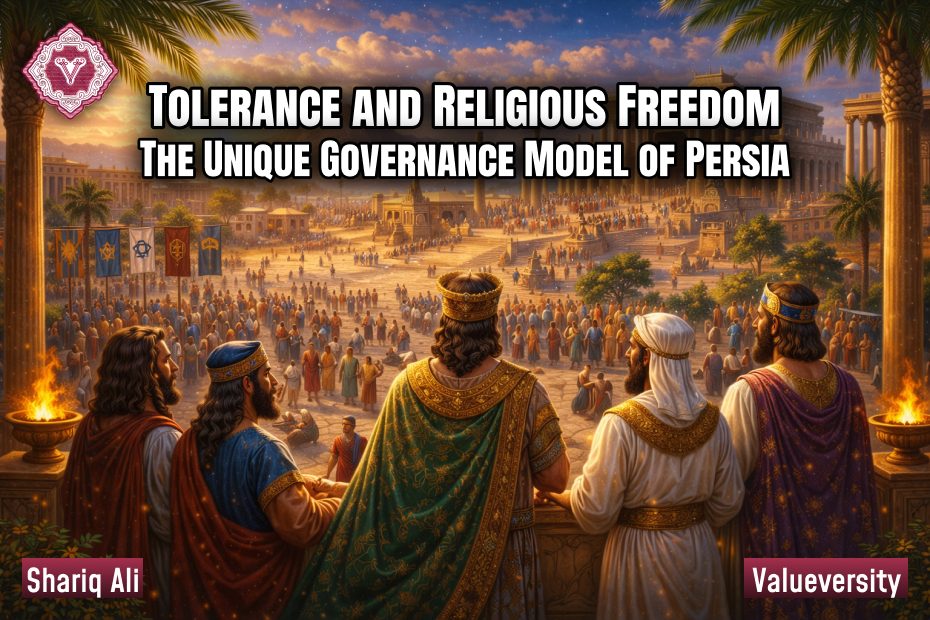
Tolerance and Religious Freedom — The Unique Governance Model of Persia
Shariq Ali
Valueversity
When we think of ancient empires, images of power, conquest, and oppression usually come to mind. However, ancient Iran—particularly the Achaemenid Empire—offers a strikingly different example. It was an empire where power coexisted with tolerance.
The foundation of this model was laid by Cyrus the Great. When he conquered Babylon, contrary to common practice, he neither destroyed the city nor interfered with the beliefs of its people. Instead, he allowed local religions, places of worship, and cultural traditions to continue and flourish.
In this context, the Cyrus Cylinder is often regarded as an early “charter of rights,” as it reflects principles of religious freedom and respect for local customs.
This policy was not an isolated act but part of a well-structured system. The empire was divided into provinces, known as satrapies, where local governors were granted administrative autonomy. Diverse nations, languages, and religions coexisted within a single political framework while preserving their distinct identities.
This approach contributed to the stability of the empire despite its vast size. It transformed power from a tool of oppression into a source of trust.
In today’s world, where multicultural societies often present challenges, the Persian model serves as a reminder that sustainable governance is built not merely on laws, but on respect, tolerance, and inclusion.
It is a quiet yet powerful message from history:
True strength lies not in suppressing differences, but in giving them space.